Real results from a law firm engagement, built on the same system we bring to New York — read the full case study →
The Website Is Still Where Everything Lands
Every AI citation, every ranked search result, every referral from another New Yorker eventually points at one place: the firm's own website. AI SEO for New York law firms is what gets a firm named and found — this page is about what has to be true once someone actually clicks. In a market carrying the largest attorney population of any state in the country, that click doesn't come with much patience attached. A visitor comparing a shortlist of names an AI system just handed them will bounce off a slow, confusing, or generic-feeling site in seconds, and try the next name on that list instead.
Built to Be Read by Machines, Not Just People
A modern law firm site has two audiences reading it at once: the human deciding whether to call, and the crawler deciding whether to cite. Structured data — Organization, Attorney, Service, and FAQPage schema, wired together consistently across every page — is how a firm tells an AI system exactly who it is, what it does, and where it operates, instead of hoping the system infers it correctly from unstructured paragraphs. A site with no schema is asking an AI crawler to guess. A site with clean, consistent schema is handing it the answer directly.
Speed matters just as much, for a blunter reason: most of the traffic a well-optimized New York firm earns now arrives already primed with a specific question, having read an AI-generated summary before ever landing on the page. That visitor is testing whether the site actually backs up what the AI said about it. A page that takes four seconds to load has already started losing that test before a single word gets read.
Getting a page into that AI-generated summary in the first place is a separate discipline from building the page itself — the mechanics of earning that citation are covered on AI SEO for New York law firms, and the two pieces of work are meant to run together rather than in sequence.
Five Boroughs Deserve Five Different Conversations, Not One
The single biggest structural mistake we see on New York City firm sites is a single, undifferentiated "practice areas" page trying to speak to a Manhattan corporate client, a Brooklyn tenant, and a Staten Island family law client all at once. It doesn't work, because their situations genuinely aren't the same. The Civil Court of the City of New York runs a separate courthouse in each borough except the Bronx, which has two, each one handling General Civil claims up to $50,000, Housing Court matters, and Small Claims up to $10,000 — and a site that reflects that borough-by-borough reality, rather than flattening it into one page, reads as dramatically more credible to both a human visitor and an AI system evaluating it. This is exactly the kind of structural depth AI SEO for New York law firms is built to translate into actual citations.
Housing law is the clearest example of why this matters. Every borough has its own dedicated Housing Court, plus two additional community courts specifically for housing matters — one in Harlem, one in Red Hook. A firm's landlord-tenant content that never mentions which borough's Housing Court it's talking about is missing the detail that actually determines procedure, timelines, and even which forms apply.
A site that talks about ‘New York’ in the abstract is competing with all 293,648 attorneys in the state at once. A site that talks about Housing Court in Red Hook is competing with almost nobody.
James Harmiden · Founder & CEO, Lexscale.ai
The Co-Op and Condo Board Problem, Rendered Correctly
Real estate is one of the clearest places where a generic template fails a New York City firm outright. Buying or selling a Manhattan co-op means navigating a board with genuine approval power over the transaction, financial disclosure packages, and bylaws that function almost like a private layer of governance layered on top of ordinary real estate law — a dynamic that barely exists in most of the country. A site that treats "New York real estate law" the same way it would treat real estate law in a market without co-op boards is leaving out the exact substance a prospective buyer or seller is actually trying to understand. This guide to SEO for real estate attorneys goes deeper on how that kind of specific, technical content gets structured to actually rank and get cited.
The After-Hours Layer: Chatbots and Receptionists
New York doesn't stop being New York at 6 p.m. A tenant just served an eviction notice on a Friday evening, or someone in a car accident on the FDR at 11 p.m., isn't going to wait until Monday morning to start looking for a lawyer — and in a market with 293,648 attorneys to choose from, whichever firm actually answers first has a real edge. A well-built chatbot, tuned to sound like a knowledgeable member of the firm rather than a scripted bot, can qualify that visitor, answer the basic questions, and capture their information the moment they land — instead of losing them to whichever competitor's site happens to respond faster.
An AI receptionist covers the other half of that same gap: the calls that come in after the front desk has gone home. In a five-borough market this dense, a missed call at 9 p.m. isn't a missed opportunity in the abstract — it's a lead who is, at that exact moment, also looking at the next name an AI system handed them. The New York growth hub covers how the website, the chatbot, and the receptionist work together as one system rather than three separate purchases.
What a Well-Built New York Firm Site Actually Looks Like
Fast on every connection, not just fiber in a Midtown office. Schema that accurately describes every practice area and every attorney. Practice area pages that acknowledge which borough's court system actually applies, rather than speaking generically about "New York." Attorney bios with real depth instead of a two-line placeholder. A contact path that works instantly on a phone, because a large share of New York's after-hours traffic is someone standing on a subway platform, not sitting at a desk. The New York growth hub lays out how this piece and the visibility work described on AI SEO for New York law firms fit together as one system.
What Slow Actually Costs in a Market Like This
A three-or-four-second load time doesn't sound like much until it's measured against what's actually competing for that visitor's attention: a shortlist of other names an AI system just handed them, all one tap away. In most American cities, a slow site loses some fraction of visitors to impatience. In New York, a slow site loses visitors to a competitor's site that's genuinely one thumb-swipe away on the same results page or the same AI-generated answer — there's no meaningful gap between "give up" and "try the next name" for someone standing on a subway platform with one bar of signal.
Case Study · Law Firm Engagement
From a 140-Page WordPress Site to a 570-Page AI Legal Website
Lexscale.ai transformed this law firm's website from an approximately 140-page WordPress website into an approximately 570-page AI-ready legal website — adding practice-area depth, supporting legal insights, service-area content, legal calculators, interactive guided wizards, structured data, and strategic internal linking, on faster, purpose-built infrastructure.
The result: organic website traffic tripled within 90 days. Results vary by firm, market, and existing authority — but a New York build follows the identical process, adapted specifically for the city's five-borough court structure and Rule 7.1 advertising compliance.
Since then, this same law firm's visibility in Google AI Overviews has grown from 4.9K to 82.5K impressions in 3 months — verified directly in Google Search Console.
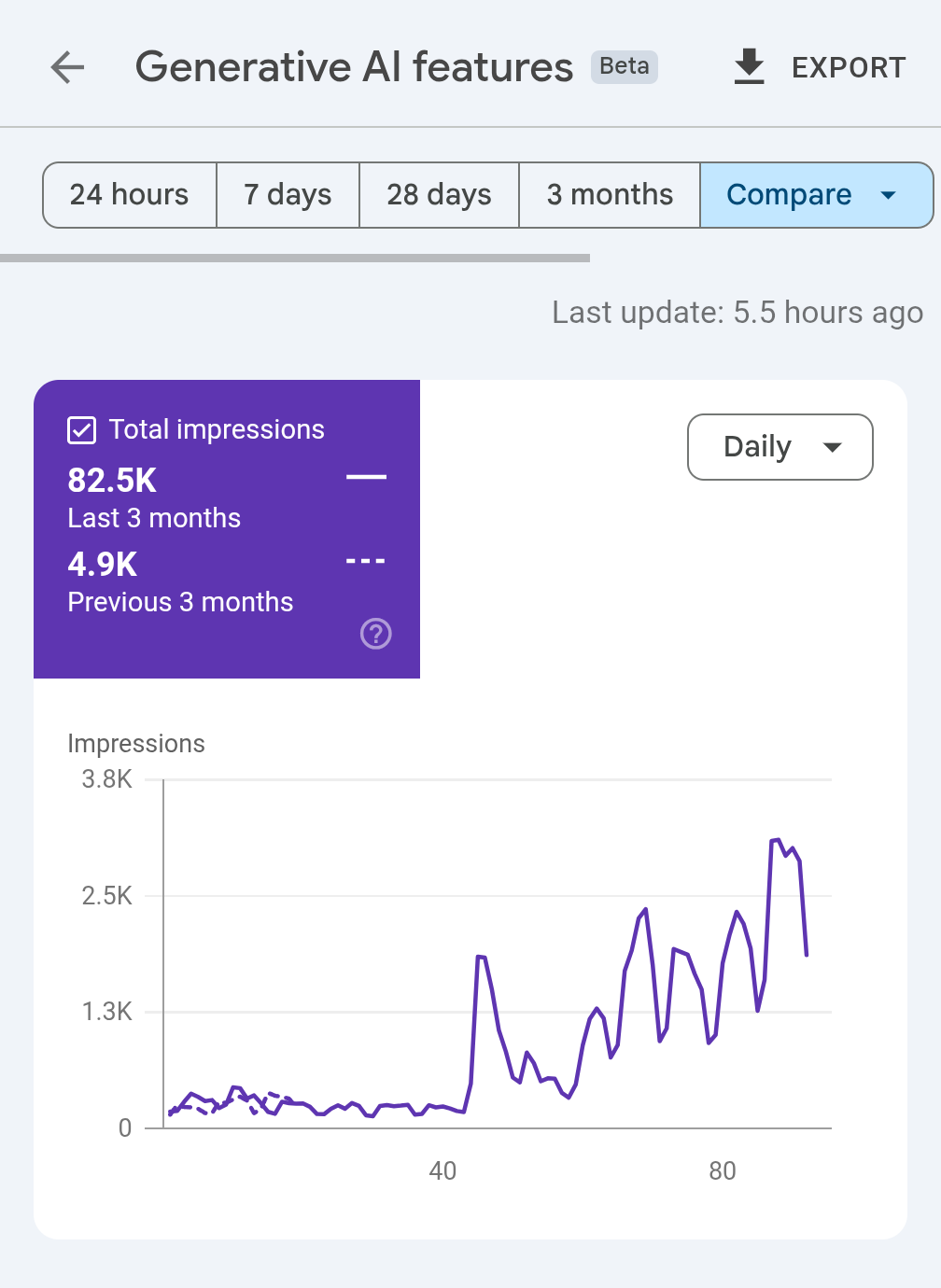
Source: Google Search Console — Generative AI features report, this law firm's own property.
Trust Signals Matter More When Nobody Already Knows Your Name
In a smaller market, a firm's reputation travels by word of mouth long before a website ever gets a chance to make the case. New York doesn't work that way for most firms outside a handful of legacy names. A huge share of the people landing on a New York City law firm's site for the first time have never heard of that firm before, have no mutual connections who could vouch for it, and are deciding — in the first few seconds — whether the site in front of them looks like a real, credible, competent operation or not.
That puts unusual weight on the details a firm might otherwise treat as secondary. Attorney bio pages that name actual bar admissions, actual case history, and actual courtroom experience read as dramatically more trustworthy than a two-paragraph placeholder with a stock photo — and they give an AI system real, specific facts to draw on when it's deciding whether to cite a source as an authority. Real client outcomes, described specifically and honestly rather than in vague marketing language, do the same work for a human reader deciding whether to pick up the phone.
Consistency across every platform matters just as much. A firm name spelled two different ways between its website, its Google Business Profile, and a legal directory listing reads as sloppy to a person and as unreliable to an AI system trying to confirm that the entity behind all three listings is actually the same firm. AI SEO for New York law firms covers why that consistency has become one of the clearest signals AI systems use to decide who to trust enough to cite.
Practice Area Pages Built for Actual Depth, Not a Paragraph and a Photo
A one-paragraph description under a stock photo of a courthouse doesn't do much for a human reader trying to figure out if a firm actually handles their situation, and it does even less for an AI system trying to decide whether a page is worth citing as a real answer to a real question. Every practice area page on a well-built New York City site needs enough substance to actually be useful — what the process looks like, which court or borough it runs through, what a client should expect, and what makes this firm's approach to it different from the next firm's.
That depth is exactly what separates a page an AI system might cite from one it scrolls past. Thin content competing against 293,648 other attorneys statewide has almost no chance of standing out. Genuinely useful, specific, borough-aware content has a real one — not because it's longer for the sake of being longer, but because it actually answers more of what the person searching needed to know.
A City That Speaks More Languages Than Almost Anywhere Else on Earth
New York City is routinely described as the most linguistically diverse city in the world, and that diversity isn't evenly distributed — it clusters differently in Queens than it does in the Bronx or on Staten Island. A firm serving immigration clients, or family law clients, or personal injury clients across multiple boroughs is very likely serving people whose first language isn't English, and a site with no thought given to that reality is quietly turning away a meaningful share of the market before a single word gets read. This guide to multilingual law firm websites covers what that actually looks like done well, beyond a machine-translated toggle bolted onto an English-only site.
Accessibility matters for a related, more concrete reason: New York has one of the highest volumes of ADA website accessibility litigation in the country, and a law firm's own site being inaccessible to a visitor using a screen reader is a genuinely bad look for a business built on legal compliance. This guide to website accessibility covers the baseline every New York City firm site should already meet.
Why This Isn't a Job for a Generalist Agency
A New York marketing agency that mostly builds sites for restaurants and retail knows how to make something look good. It rarely knows that advertising claims under Rule 7.1 of the New York Rules of Professional Conduct have to be retained for a defined period, or that a "before/after" testimonial framed the wrong way can create real exposure for a law firm in a way it never would for a restaurant. The New York growth hub covers why that gap matters and what building this the right way actually looks like.
It also rarely thinks about AI citation at all, which is a separate discipline covered in full on AI SEO for New York law firms — a site built without that in mind is starting the visibility side of the work a step behind before it even launches.
From My Experience — James Harmiden
The first time I audited a New York City firm's site, the practice area page for real estate never once mentioned a co-op board. Not once. The firm's actual work was full of board package disputes and financing contingencies tied to bylaws — genuinely technical, genuinely New York-specific work — and none of it made it onto the page a prospective client would actually read before calling. The site described a version of real estate law that doesn't really exist here.
That's the pattern I keep seeing across New York firm websites more than any other city I've worked in: real, specific, hard-won expertise sitting behind a homepage written like it could belong to a firm in any state. The five-borough court structure is the same story. A site that talks about "New York City housing law" as one undifferentiated topic is quietly telling both visitors and AI systems that it hasn't actually engaged with which Housing Court — Manhattan's, Brooklyn's, the one in Red Hook — a given client is walking into.
Rebuilding a New York site correctly isn't about making it prettier. It's about finally letting the site say out loud what the firm already knows how to do — down to the borough, down to the courthouse — instead of hiding it behind boilerplate that could describe anyone.
— James Harmiden, Founder & CEO, Lexscale.ai