A Toronto Law Firm in a Crowded Legal Market
Legal Solutions Law Firm (LegalSolutionsLawFirm.ca) operates in the Toronto legal market — one of the most competitive in North America, where prospective clients have dozens of firms to choose from for nearly every practice area. Standing out in that environment increasingly depends on how well a firm's website is structured, not just how it looks.
The Limitations of the Previous WordPress Website
Before this engagement, the firm's website ran on WordPress with approximately 140 pages — a modest footprint for a firm competing across multiple practice areas in a market as dense as the GTA. Like many WordPress law firm sites of that size, it carried the common limitations of a smaller, template-driven build: comparatively thin coverage per practice area, limited supporting content, and a content management system carrying technical overhead that hadn't been fully leveraged for search or AI visibility.
The Website Architecture and Migration Strategy
Rather than a cosmetic redesign, the engagement started with a full information-architecture rebuild: mapping every practice area the firm needed represented, planning a content structure that could scale well beyond the existing 140 pages, and rebuilding the site on faster, more scalable infrastructure than the original WordPress install. The migration was planned to preserve the value already built into the existing site rather than starting from zero.
Expansion to Approximately 570 Pages
The finished site expanded from roughly 140 pages to approximately 570 — a five-fold increase in scope, built around a coherent architecture rather than simply adding volume. Each new page was planned to serve a specific purpose within the site's practice-area structure, not published as a standalone, disconnected document.
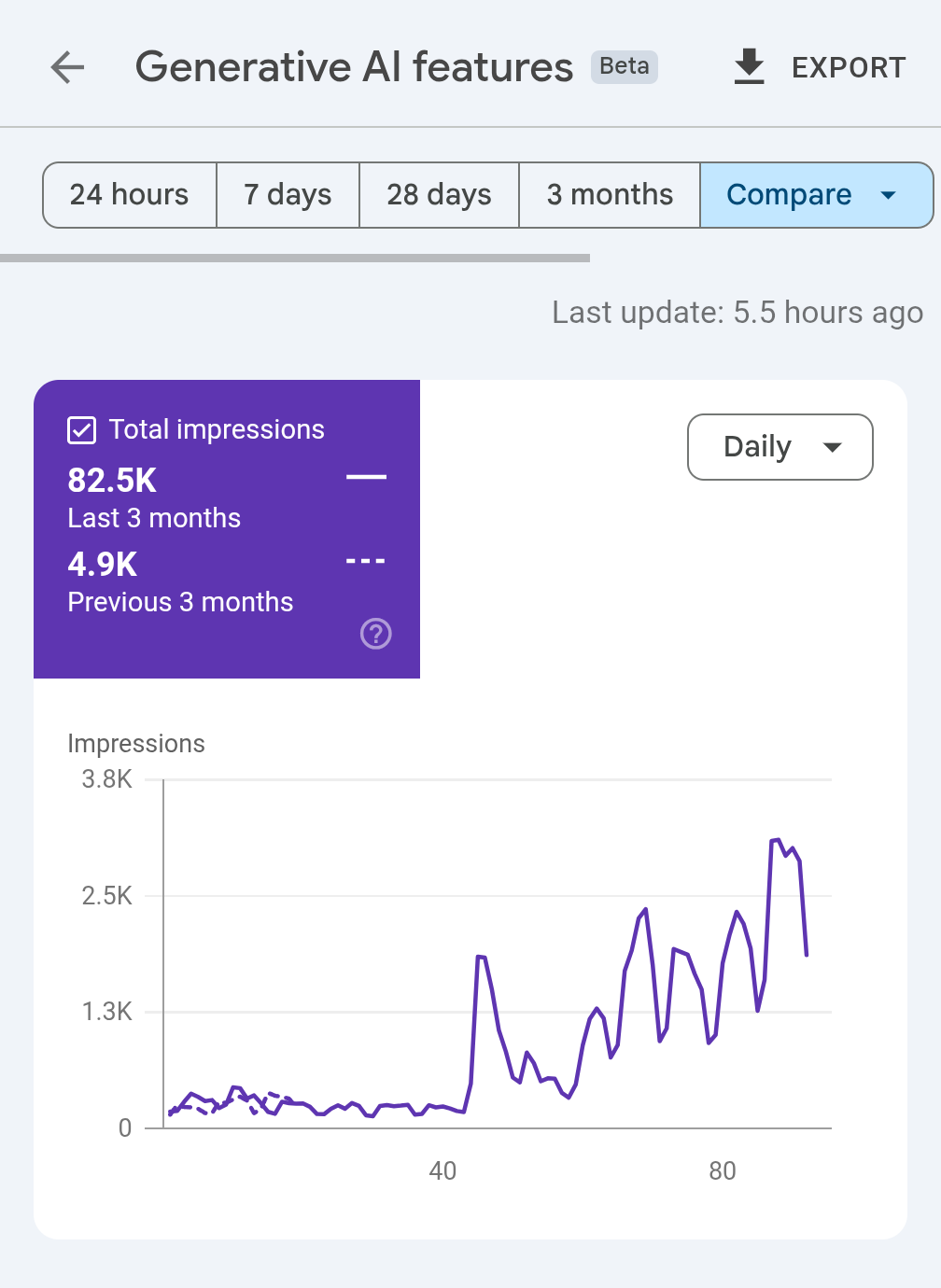
Source: Google Search Console — Generative AI features report, this law firm's own property.
Practice-Area and Supporting-Content Development
The expanded site included detailed practice-area content covering the firm's core areas of work, supporting legal insight articles addressing the specific questions prospective clients search for, and content grounded in the firm's actual Toronto and GTA service area. This depth is what separates a genuinely useful legal resource from a thin marketing site — and it's the foundation both search engines and AI systems need to recognize a site as authoritative.
Legal Tools, Calculators, and Guided Wizards
The engagement also integrated relevant legal calculators and interactive guided wizards from Lexscale.ai's tool library into the site — giving visitors practical resources to use directly, rather than requiring them to contact the firm just to get a basic answer. Tools like these are a differentiator very few competing law firm websites in the Toronto market currently offer.
Technical SEO, Structured Data, and Internal Linking
Alongside the content build, the site received a full technical SEO pass: schema markup describing the firm, its practice areas, and its content; clean, AI-crawlable page structure; and strategic internal linking connecting related practice-area and supporting pages into coherent topic clusters rather than isolated documents. This is the same technical foundation described on the AI website design for Toronto law firms page.
The traffic result gets the attention, but it's the architecture underneath that made it possible — 570 pages that actually connect to each other beats 570 pages that don't, every time.
James Harmiden · Founder & CEO, Lexscale.ai
The Result: Organic Traffic Tripled in 90 Days
Within 90 days of the new site launching, the firm's organic website traffic tripled. That result reflects the combined effect of the expanded content depth, the technical and structured-data foundation, and the internal linking structure built during the engagement.
Results like this vary from firm to firm, depending on the firm's starting position, the competitiveness of its practice areas and market, its existing authority and backlink profile, and how fully a strategy is implemented. This case study describes one engagement's outcome, not a guaranteed result for every firm.
Lessons for Other Toronto Law Firms
The clearest lesson from this engagement is that page count alone was never the point — a 570-page site built without real structure or depth would not have produced the same result. What moved the needle was the combination of genuine content depth, a coherent practice-area architecture, technical SEO and structured data, and tools that gave visitors a reason to engage. A Toronto firm considering a similar rebuild should weigh all four together, not treat any one of them as sufficient on its own.
Considering an AI Website for Your Toronto Firm?
Book a free strategy call to talk through what an AI-ready website could look like for your practice — no obligation. Or see the full approach on our AI website design for Toronto law firms page.
Book a Free Strategy Call →