Real results from a law firm engagement, built on the same system we bring to New York — read the full case study →
Getting Found When Nearly 300,000 Attorneys Are Competing for the Same Client
New York State has 293,648 registered attorneys, the largest attorney population anywhere in the country, and most of that concentration sits inside New York City, heaviest of all in Manhattan. Traditional search engine optimization — targeting keywords, building links, hoping to climb ten blue results — was already a hard fight in a market this size. It gets harder still now that a growing share of the people typing a legal question into their phone never make it to a results page at all. AI website design for New York law firms is what makes a site worth citing once it's found. This page is about earning that citation in the first place.
For a broader look at how the website side and the visibility side fit together across all five boroughs, the New York growth hub is the place to start; this page stays focused specifically on what earns the citation.
Four Systems, Four Ways They Stand Between a Client and Your Website
Google's AI Overview now sits at the very top of a huge share of legal search results, answering the question directly and naming a short list of sources before a single traditional listing appears below it. A firm that isn't one of those named sources can rank respectably on the page below and still lose the click, because the answer the visitor needed already arrived.
ChatGPT gets asked questions like "do I need a lawyer for this eviction notice in Brooklyn" or "how does a co-op board approval actually work in a Manhattan sale" constantly, and it responds with specific, named sources rather than a list of links to click through. Gemini is built directly into the Android and Google Search experience most New Yorkers are already using every day, which means it's frequently the first system a person consults without ever consciously choosing an "AI tool" at all. Perplexity was designed from the ground up to cite its sources by name inside the answer itself, functioning less like a search engine and more like a research assistant that tells you exactly who it trusted.
Each of those four systems now functions as a gatekeeper standing between a New York client and a firm's website — deciding which handful of names even get surfaced before the person has clicked anything. The New York growth hub covers what that shift means for the market as a whole; this page is about the specific mechanics of earning a place in that shortlist.
Ranking on page one used to be the finish line. In New York now, the finish line moved — it's whichever name Google's AI Overview, ChatGPT, Gemini, or Perplexity actually says out loud.
James Harmiden · Founder & CEO, Lexscale.ai
What Each of the Four Systems Actually Rewards
The four systems don't all weigh the same signals the same way, which is part of why a single piece of content can perform very differently across them. Google's AI Overview leans heavily on the same technical and structural foundation that's long mattered for traditional search — schema, page speed, established domain trust — layered with a stronger preference for content that answers the question directly in the first few sentences. ChatGPT and Gemini both draw on a broader mix of training data and real-time retrieval, which rewards content that reads as genuinely authoritative and well-established over time, not content that just went live last week. Perplexity is the most transparent about its sourcing of the four, and it tends to favor content it can point to with a specific, confident citation — vague or hedged writing gets passed over in favor of a source that states something clearly and backs it up.
None of that means a firm needs four separate content strategies. It means the underlying content has to be specific, well-structured, and genuinely authoritative enough to satisfy all four at once — which is the same bar this page has been describing throughout, applied consistently rather than gamed for any one system in particular.
Precision Beats Scale in a Market This Large
It seems counterintuitive at first: shouldn't a market with 293,648 attorneys be too crowded for a smaller firm to compete in? In practice, the opposite tends to hold. An AI system answering a specific question isn't scanning all 293,648 attorneys and picking the most famous one — it's looking for whichever source most precisely and clearly answers that exact question. Ask about eviction procedure in Red Hook's community Housing Court specifically, and an AI system is looking for content that actually engages with that court, not a firm's generic "New York landlord-tenant law" page. Most competitors in a market this size never bother writing at that level of specificity, which is exactly the opening a smaller, precisely built content strategy can take advantage of. AI website design for New York law firms covers what the site itself needs to support that kind of precision structurally.
Local Law 136 Is a Genuine Content Opportunity
Local Law 136 of 2017 made New York City the first jurisdiction in the country to guarantee free legal counsel to income-eligible tenants in Housing Court, with the program fully implemented across all five boroughs by 2022. That's not just a policy footnote — it's a real, citable, jurisdiction-specific fact that most generic "landlord-tenant law" content anywhere else in the country simply doesn't have access to. Content that accurately explains how right-to-counsel actually changes a Housing Court case, borough by borough, gives an AI system something specific and current to cite — instead of the same generic advice it can already find repeated across a thousand other sites.
Rule 7.1 Shapes What Content Can Actually Say
New York regulates attorney advertising through Rule 7.1 of the Rules of Professional Conduct, administered ultimately through the New York State Unified Court System's four Appellate Divisions rather than a single provincial body. One requirement in particular trips up firms working with a generalist agency: copies of advertisements and marketing communications have to be retained for a defined period, not just kept honest in the moment they run. Every claim built into a New York SEO campaign — every "leading," every superlative, every case-result reference — gets checked against that standard before it goes live, not cleaned up after a complaint. The New York growth hub covers why this matters more than most firms realize when comparing agencies.
What Actually Earns a Citation Here
Specific, current, jurisdiction-accurate content beats generic volume every time an AI system is deciding who to cite. That means naming the actual borough court a process runs through, referencing real current law like Local Law 136 instead of dated boilerplate, and structuring that content with clean schema so a crawler doesn't have to guess what it's reading. It also means consistency — the same firm name, the same practice area descriptions, the same attorney details — across the website, Google Business Profile, and every other place a firm's information appears online, because AI systems use that consistency as one of the signals for whether an entity is real and trustworthy enough to cite.
Content depth that engages seriously with New York's co-op and condo board real estate complexity, rather than a generic real estate law page, is a strong example of the kind of specificity that gets rewarded here — the same approach covered in this guide to real estate attorney SEO and in this guide to building topical authority.
Generic State-Wide Content vs. Borough-Specific Content
Building Topical Authority Across Ten Practice Areas and Five Boroughs
One page about landlord-tenant law and one page about personal injury don't make a firm an authority on either topic — not to a human reader comparing options, and not to an AI system deciding who to cite. Authority gets built through depth across a real cluster of related content: the borough-specific Housing Court process, what Local Law 136 right-to-counsel actually changes about a case, how a security deposit dispute plays out differently in Civil Court's General Civil track versus Small Claims. A single page can rank. A genuine cluster of specific, connected content is what actually gets treated as a trustworthy, citable source. This guide to building topical authority covers the mechanics in more depth.
The same principle holds across every one of the ten practice areas a New York firm might cover — personal injury, family law, criminal defense, immigration, estate planning, real estate, employment, corporate, bankruptcy, and workers' compensation. A firm doesn't need content depth in all ten to start earning citations. It needs real depth in whichever two or three actually drive its caseload, built specifically enough that an AI system has a clear reason to name that firm over the next one.
Tracking Whether Any of This Is Actually Working
Traditional SEO reporting — rankings, organic traffic, keyword position — still matters, but it doesn't answer the question that matters most now: is a firm actually being named when ChatGPT, Gemini, Perplexity, or Google's AI Overview answers a relevant legal question. That requires directly checking what each of those four systems says when asked the kinds of questions a real New York client would ask, borough by borough and practice area by practice area, and tracking whether a firm's name shows up in the answer over time.
That tracking is also how a firm knows whether its Rule 7.1-compliant content strategy on the New York growth hub is actually closing the gap against a market this saturated, or whether it needs to go deeper on a specific borough or practice area first. Guessing isn't a strategy in a market with 293,648 attorneys already competing for the same attention — measuring what an AI system actually says is.
Case Study · Law Firm Engagement
From a 140-Page WordPress Site to a 570-Page AI Legal Website
Lexscale.ai transformed this law firm's website from an approximately 140-page WordPress website into an approximately 570-page AI-ready legal website — adding practice-area depth, supporting legal insights, service-area content, legal calculators, interactive guided wizards, structured data, and strategic internal linking, on faster, purpose-built infrastructure.
The result: organic website traffic tripled within 90 days. Results vary by firm, market, and existing authority — but a New York AI SEO engagement follows the identical process, adapted specifically for the city's five-borough court structure and Rule 7.1 advertising compliance.
Since then, this same law firm's visibility in Google AI Overviews has grown from 4.9K to 82.5K impressions in 3 months — verified directly in Google Search Console.
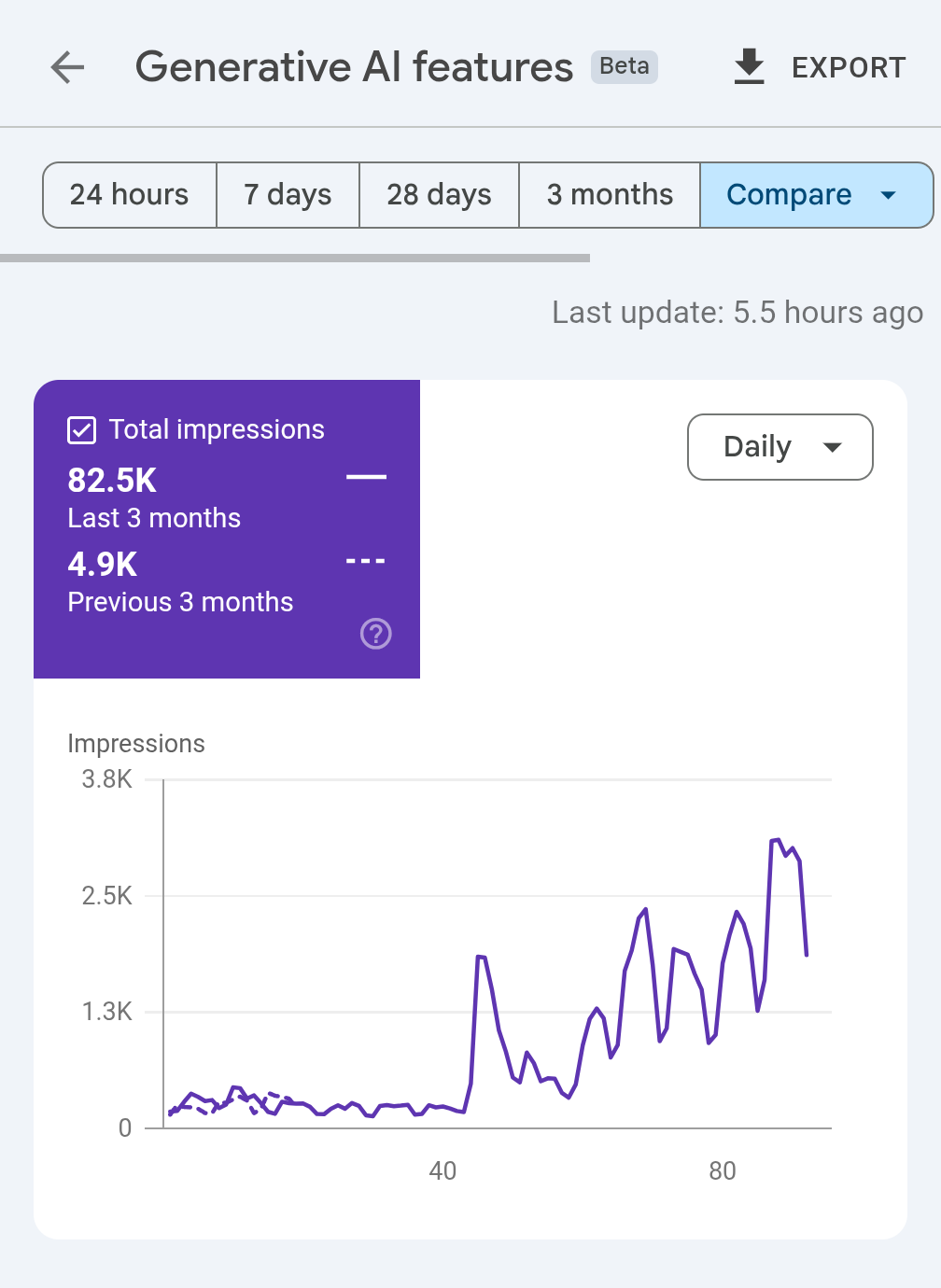
Source: Google Search Console — Generative AI features report, this law firm's own property.
Why Consistency Across Platforms Decides Who an AI System Trusts
A firm's Google Business Profile, its website, its listing on legal directories, and any citation in local press all need to describe the same firm, the same practice areas, and the same contact details — because AI systems increasingly use that cross-platform consistency as a signal for whether an entity is real and stable enough to cite with confidence. A firm listed as "Smith Law" in one place and "Smith & Associates LLP" in another, with a phone number that doesn't match between its site and its Google Business Profile, reads as unreliable data — and unreliable data doesn't get cited, no matter how good the underlying content is.
This matters more in New York than in a smaller market precisely because of the scale problem: with 293,648 attorneys statewide to sort through, an AI system leans harder on structural trust signals like entity consistency to narrow the field before it ever gets to evaluating content quality. Google Business Profile optimization is a natural companion to this work — see Google Business Profile for New York law firms for the mechanics — but the consistency has to extend to every platform a firm appears on, not just one.
Building This Without Losing What Already Works
A New York firm with existing Google rankings doesn't need to start over — AI SEO is built on top of that foundation, not instead of it. The technical work — schema implementation, borough-level content restructuring, entity consistency — is planned with redirects and existing equity in mind, the same way a website rebuild is. The goal is a firm that ranks well in traditional search and gets named directly inside Google AI Overviews, ChatGPT, Gemini, and Perplexity — not a tradeoff between the two.
That coordination between the site and the visibility strategy is exactly what the New York growth hub is meant to help a firm plan out, and AI website design for New York law firms covers the technical side of the rebuild itself in more depth.
From My Experience — James Harmiden
The question I get most often from a New York firm is some version of: how do we possibly stand out against 293,648 other attorneys in this state? I understand the instinct behind the question, but it's the wrong frame. An AI system isn't ranking all 293,648 of you against each other for one generic query. It's answering one specific question from one specific person, and it's looking for whoever answered that specific question best.
The firms I've watched actually break through in New York didn't try to out-shout a market this size. They picked something real and specific — Local Law 136's effect on a Housing Court case in a particular borough, the mechanics of a co-op board rejecting a sale, the exact civil claims limit in Staten Island's Small Claims Court — and wrote the most useful page on the internet about it. That's a fight a firm with five attorneys can win against a firm with five hundred, because the AI system doesn't care about headcount. It cares about which page actually answers the question.
Five boroughs means five real, distinct legal environments layered under one city. Most firms here still write as if there's only one. The ones that stop doing that first are the ones I expect to be the names ChatGPT and Google's AI Overview are still citing three years from now.
— James Harmiden, Founder & CEO, Lexscale.ai