Real results from a Toronto law firm engagement, built on the same system we bring to Mississauga — read the full case study →
Why Mississauga Law Firms Need More Than a Template Website
Most Mississauga law firm websites fall into one of two categories: a generic legal-industry template with a logo swapped in, or a Toronto-market template with the word "Mississauga" inserted a few times. Neither has the technical structure — clean semantic HTML, proper schema markup, fast load times, clear entity signals — that AI crawlers need to understand who you are, what you practice, and why you should be trusted for this specific market. See why law firms need AI-optimized websites in 2026 for the fuller picture of why this shift matters.
This page covers what that actually takes for a firm operating in a market this corporate-dense, and how it feeds into AI SEO for Mississauga law firms — the part of the equation that determines whether anyone finds the site at all.
Template Website vs. AI-Optimized Website
A website that reads like a Toronto template with the city name changed doesn't fool an AI system any more than it fools a client. Real local specificity is a trust signal — and it's exactly what most Mississauga firms are missing.
James Harmiden · Founder & CEO, Lexscale.ai
What Makes a Website "AI-Optimized" in 2026
Strip away the jargon and an AI-optimized site answers one question fast, for two different readers at once: a crawler parsing your markup and a stressed-out visitor scanning on their phone. Both need the same thing — headings that say plainly what a page covers, and structured data spelling out your firm's name, practice areas, service area, and credentials in a format a machine doesn't have to guess at.
It also has to go deep on what actually generates a Mississauga file: a corporate layoff near one of the head offices clustered around the airport, a commercial lease dispute along that same corridor, a real estate closing tied to the condo boom around Square One. Write a thin paragraph on each and there's nothing there for an AI system to point to with confidence — depth is what earns the citation.
Speed Is a Prerequisite, Not a Nice-to-Have
None of the content strategy, schema markup, or entity work below matters if the page carrying it takes four seconds to appear. Core Web Vitals feed directly into Google's ranking algorithm, and a slow site simply gets crawled less often and less completely by the AI systems trying to build a picture of what's on it.
Almost every legacy Mississauga law firm site we've audited traces its slowness back to the same cause — a content management system that's accumulated years of unused plugins, uncompressed images, and bloat nobody ever cleaned out. An AI-optimized rebuild throws that weight out and starts from lean, purpose-built code instead of a general platform never designed for a law firm's needs in the first place.
Structure Is What AI Actually Reads
An AI system doesn't experience a page the way a person does — it maps the skeleton underneath the words. One H1 per page stating the real topic, H2s that mark genuine sections rather than decorative breaks, and internal links that connect related ideas on purpose: an employment page linking to a wrongful dismissal FAQ, which links to a severance calculator, forming a cluster the system can walk through as one connected body of knowledge rather than a scatter of disconnected pages. For a sense of scale, how many pages a Mississauga law firm website should have breaks down what that structure typically requires.
It also means nothing load-bearing hides behind JavaScript a crawler might not fully render. Firm name, practice areas, service area, contact details — the facts a firm most needs recognized — belong in plain HTML, not injected client-side after the fact.
Schema Markup for Mississauga Law Firm Websites
Schema markup is the structured data layer that explicitly tells search engines and AI systems what a website contains. For a Mississauga firm, this typically includes LegalService schema describing the firm, Attorney or Person schema for each lawyer with sameAs links to their Law Society of Ontario profile and LinkedIn, FAQPage schema matching visible FAQ content, and BreadcrumbList schema clarifying site structure.
It is also the piece most Mississauga firm sites skip entirely — see what schema markup is and why a Mississauga law firm's website needs it for the full breakdown. Get it right and you've handed AI systems the exact structured facts they need to build confidence in your firm as a real, verifiable entity — which is the difference between showing up in an answer and being invisible to it. There's no clean line separating this from AI SEO strategy; schema is technical website work and visibility work at the same time.
Conversion Design for a Multicultural, Corporate-Adjacent Client Base
Visibility and technical structure only matter if the website actually converts visitors into booked consultations. For a Mississauga firm, that means a clear, low-friction path to contact on every page, and trust signals placed where a hesitant visitor needs them — credentials, case results worded to comply with Law Society of Ontario rules, and specific, honest descriptions of what happens after someone reaches out.
It also means designing with Mississauga's genuinely multicultural client base in mind — clear, accessible language, and where relevant, multilingual considerations that reflect the city's large South Asian, Chinese, and broader immigrant communities, rather than assuming a single default client profile.
Mobile-First Design for a Commuter City
A significant share of legal searches in Mississauga happen on mobile devices, often during a commute on the QEW or 403, or in the moments after a stressful call or meeting. A website designed primarily for desktop and merely "responsive" on mobile creates friction at exactly the wrong moment.
Mobile-first design means the primary call-to-action, phone number, and contact form are immediately visible and usable without hunting through a menu, and forms are short enough to complete comfortably with a thumb. For a Mississauga firm, this is directly tied to how many of the visitors an AI SEO strategy earns actually convert into consultations, since a large share of that traffic arrives on a phone.
This matters more for a commuter city than it might elsewhere. A prospective client stuck in traffic on the 403 or waiting for a GO train has a narrow window of attention — a slow-loading page or a form that won't render properly on a small screen loses that window entirely, and the visitor moves on to the next search result.
Building the Website to Survive an LSO Review
Case results, testimonials, headline copy that implies a guarantee, chatbot disclosures — every one of these gets checked against Law Society of Ontario advertising standards before it ships on a Mississauga firm's site. Most generalist web design shops working across a dozen unrelated industries have no process for this at all, because it never occurs to them to look for it.
Catching it at the design stage instead of after launch saves a Mississauga firm two things: the time cost of redoing pages that should have been reviewed the first time, and the reputational cost of a marketing claim that doesn't hold up once someone actually checks it against LSO rules.
Common Website Mistakes We Fix for Mississauga Firms
The most frequent issue is content that's really written for a Toronto audience with the city name swapped — generic enough that it could describe any GTA firm, and specific enough about nothing that AI systems have no reason to cite it over a genuinely local competitor. It's the same pattern covered in is my current Mississauga law firm website losing me clients.
The second most common issue is contact information that's inconsistent between the website, footer, and Google Business Profile — different phone numbers or an outdated address. This inconsistency undermines the entity confidence both traditional SEO and AI citation depend on.
The third is missing or broken schema markup, either never implemented or left to rot as content changed without the structured data being updated to match.
A fourth, less obvious issue is attorney bio pages treated as an afterthought. A properly built bio, with sameAs links to a Law Society of Ontario profile and a specific description of experience, does far more for both AI citation and client trust than most firms give it credit for.
The ROI of an AI-Optimized Website for a Mississauga Firm
The direct returns are a lower bounce rate from faster load times, a higher consultation-booking rate from clearer conversion design, and a technical foundation that makes every dollar spent on AI SEO afterward more effective, because the content it produces has somewhere structurally sound to live.
The indirect return is durability. A site built on lean, purpose-specific infrastructure with proper schema markup ages more gracefully than a generic template, because the underlying architecture is built around principles — speed, clarity, structured data — that remain constant even as specific AI platforms evolve.
There is also a competitive dimension specific to a market with as much corporate density as Mississauga's. When a prospective client — often someone with a corporate or professional background who deals with vendor websites daily — is comparing several firms, a noticeably faster, clearer, more credible website becomes a quiet but real differentiator, independent of which firm technically has more years of experience.
Case Study · Toronto Law Firm
From a 140-Page WordPress Site to a 570-Page AI Legal Website
This is a Toronto engagement, not a Mississauga one — we don't yet have a published Peel Region case study — but it's the same system we'd bring to a Mississauga firm. Lexscale.ai transformed this law firm's website from an approximately 140-page WordPress website into an approximately 570-page AI-ready legal website, adding practice-area depth, supporting legal insights, service-area content, legal calculators, interactive guided wizards, structured data, and strategic internal linking, on faster, purpose-built infrastructure.
The result: organic website traffic tripled within 90 days. Results vary by firm, market, and existing authority — but a Mississauga build follows the identical process, adapted for Peel Region's market and Law Society of Ontario compliance.
Since then, this same law firm's visibility in Google AI Overviews has grown from 4.9K to 82.5K impressions in 3 months — verified directly in Google Search Console.
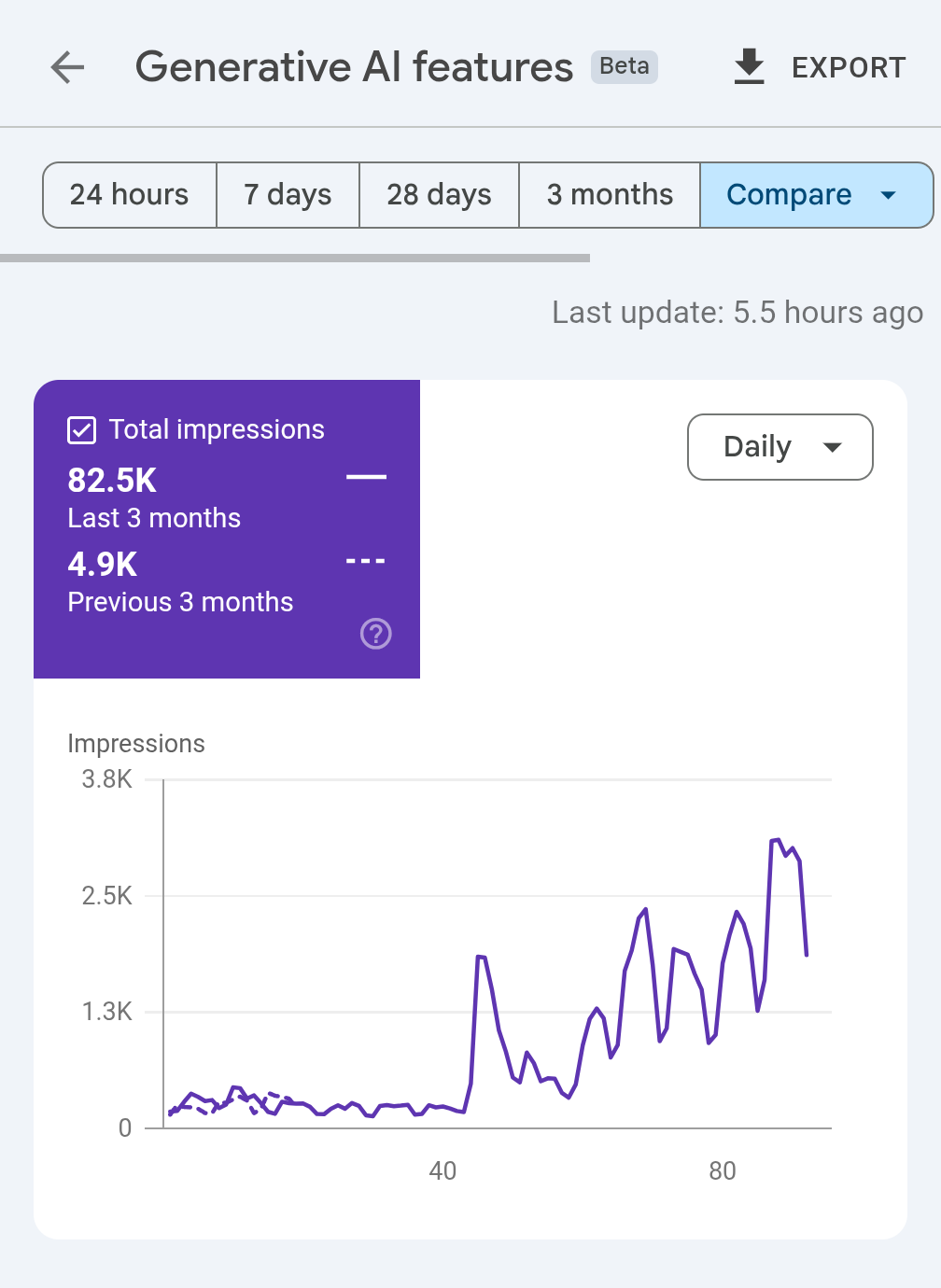
Source: Google Search Console — Generative AI features report, this law firm's own property.
Common Website Mistakes We Fix for Mississauga Firms — What They Cost
Duplicate or near-duplicate practice area pages, inconsistent contact information, missing schema, and thin attorney bios don't just look unpolished — each one is a specific, fixable reason an AI system chooses not to cite a firm. Fixing all four is usually a matter of weeks, not months, once identified through a proper audit, but most Mississauga firms have never had one done.
Pairing Your Website With AI SEO for Mississauga Law Firms
A technically excellent, fully schema-marked website still needs a visibility strategy behind it — otherwise it is simply a well-built site nobody finds. This is where AI SEO for Mississauga law firms becomes the natural next step.
The two services share the same underlying technical foundation, which is why firms that invest in an AI-optimized website almost always see the strongest results when they pair it with a dedicated AI SEO strategy.
What to Expect in the First 90 Days
A Mississauga build usually needs more attention paid to how practice pages read to a corporate legal buyer, given how many firms here work with the head offices clustered in the city, than a typical consumer-facing local build would. For the phase-by-phase breakdown, how long it actually takes to build an AI-optimized website in Mississauga has the full timeline.
A brand-new site has no search history to lean on yet, which is exactly why most Mississauga firms roll straight from launch into an ongoing AI SEO engagement rather than waiting to see what happens organically.
What the Build Process Looks Like
Because so many Mississauga firms serve corporate clients headquartered right in the city, the audit phase spends extra time on how the site presents to a sophisticated in-house legal team, not just an individual searching Google — that shapes the priorities coming out of the first strategy call. From there, Lexscale.ai runs the design, build, schema, and AI website design work directly, with Law Society of Ontario compliance built into the copywriting rather than checked afterward.
A launch-ready site typically takes a few weeks from the first call, after which most Mississauga firms shift into an ongoing AI SEO engagement. For the fuller picture beyond the website alone, the Mississauga AI growth hub is the better starting point.
Related Reading: AI Website Design Insights
Mississauga Insights: Questions Answered Directly
From My Experience — James Harmiden
A lot of the Mississauga sites I audit have the same problem, and it isn't really a design problem — it's a speed and structure problem hiding behind a design that looks fine at first glance. WordPress with years of plugins stacked on top of each other, images that were never compressed, a theme built for a generic small business rather than a law firm — the exact migration is covered in how to move a Mississauga law firm website off WordPress without losing your Google rankings. It looks presentable. It loads like a freight truck stuck on the 401 at rush hour.
That comparison isn't random. Mississauga runs on logistics — Pearson anchors one of the busiest cargo corridors in the country, and everything here moves fast because it has to. A law firm's website should move the same way. When I rebuild one of these sites, the first thing that changes is almost never how it looks. It's how fast it loads and how clearly an AI system can read what's actually on the page, because neither Google nor ChatGPT is going to wait around for a slow site to finish loading before deciding whether to trust it.
I've watched firms get measurably better results — more calls, more consultations — from a faster, properly structured rebuild than they ever got from years of paying an agency to tweak a WordPress theme. That's not a coincidence. It's what happens when you stop patching an old system and build the right one from the start.
— James Harmiden, Founder & CEO, Lexscale.ai