Real results from a Toronto law firm engagement, built on the same system we bring to Mississauga — read the full case study →
The Ten-Blue-Links Playbook Doesn't Cover Mississauga Anymore
Backlinks, keyword density, domain authority — none of it has stopped mattering, but all of it was designed for a world where someone typed a phrase into Google and worked down a list of links. A growing share of Mississauga's prospective clients skip that step entirely now. They ask ChatGPT, Gemini, or Perplexity a direct question, or they get a synthesized answer from Google's AI Overview before a traditional result ever loads — and that answer names a small handful of sources by name.
A strategy still chasing a handful of city-name keywords is fighting for a shrinking slice of that behavior. AI SEO is the discipline of building the structured data, entity signals, and content depth that get your firm named inside those generated answers instead of buried under them — and it shares its technical backbone with AI website design for Mississauga law firms, so the two are never really separate projects.
Traditional SEO vs. AI SEO
Being findable and being cited are two different things. A Mississauga firm can rank on page one and still never get mentioned by name in a ChatGPT answer — and increasingly, that's the conversation that actually decides who gets the call.
James Harmiden · Founder & CEO, Lexscale.ai
How Google AI Overviews Are Reshaping Mississauga Legal Searches
Google AI Overviews now appear above traditional results for a large share of informational legal queries — questions about tenant rights, severance entitlements, or what to do after a commercial dispute. Only a handful of sources make it into the citation list under one of those summaries, and landing in it puts a Mississauga firm in front of a prospective client before that person ever reaches a traditional blue link.
Earning that citation slot comes down to two things working together: the content has to answer the specific question asked, not circle around it, and the firm behind it needs visible E-E-A-T signals — real experience, demonstrated expertise, and evidence of authority and trustworthiness a machine can verify. A page built to target a keyword phrase instead of actually answering the reader's question gets skipped, regardless of how well that phrase was researched.
Getting Cited in ChatGPT and Perplexity as a Mississauga Firm
The mechanics behind ChatGPT and Perplexity aren't identical to Google's AI Overviews, but the goal they're chasing is the same one: find a source confident enough and relevant enough to attach a name to. For a Mississauga firm, that means the content on your site has to be specific and clearly structured enough that one of these systems can point at it and say, with confidence, this firm answered the question.
Attorney bios with genuine credentials and sameAs links to verifiable external profiles, FAQ content matching real client questions, and practice-area pages with jurisdiction-specific detail about Ontario law all meaningfully increase the odds of citation.
Entity SEO: Making Your Firm Provable, Not Just Findable
Entity SEO is about giving your firm and its lawyers a digital identity that can be checked, not just claimed — the same name, credentials, and facts showing up consistently enough across enough independent sources that an AI system can confirm them rather than take your word for it.
That cross-checking is the whole mechanism behind AI citation confidence — it's how a system decides an entity is real rather than just claimed. It's also why a firm with thinner content but rock-solid entity signals regularly out-cites a firm publishing twice as much with sloppy, inconsistent ones.
And it doesn't stay finished. Every time a Mississauga firm adds a lawyer, moves offices, or updates a phone line, that change has to land consistently on the website, in schema markup, on the GBP listing, and in any legal directory the firm appears in — one stale entry is enough to reintroduce the inconsistency that erodes trust.
Content Strategy for Mississauga's Distinct Legal Market
Mississauga's legal market is dense enough — and distinct enough from Toronto's — that thin, generic content simply does not compete. An effective AI SEO content strategy for a Mississauga firm is built around topical clusters that reflect the city's actual client base: employment content addressing corporate-layoff scenarios common near the airport corridor, commercial and business content for the city's dense head-office presence, and family and real estate content for a fast-growing, multicultural residential population.
It also has to earn a reader's trust, not just satisfy an algorithm chasing a keyword phrase. Realistic timelines, honest caveats about outcomes, and specific references to Ontario statutes and Peel Region court processes all meaningfully increase both citation likelihood and client trust.
Prioritization matters too. Rather than attempting to build every possible practice area cluster simultaneously, the strongest results usually come from picking the one or two practice areas that represent the highest-value client work for a given Mississauga firm and building genuine depth there first.
This is also where the corporate density around Pearson pays off for firms willing to build toward it: employment and commercial content aimed at professionals working for companies headquartered along the airport corridor faces less entrenched competition than personal injury or family law content, where every GTA firm is already publishing at volume.
Schema Markup and Structured Data Essentials
Structured data is what lets an AI system verify a claim instead of just reading it. For a Mississauga firm that means, at minimum, LegalService or ProfessionalService schema for the practice, Attorney or Person schema per lawyer, FAQPage tags matched word-for-word to what's actually on the page, BreadcrumbList sitewide, and Article schema with real dates on every insight piece.
None of that stands apart from the site's own architecture — AI website design for Mississauga law firms is where the other half of this work actually gets built.
Google Business Profile Optimization for Peel Region
Google Business Profile remains a critical visibility surface for any Mississauga firm, feeding both traditional local search results and increasingly AI-driven local recommendations. A fully optimized profile includes accurate, consistent categories matching your actual practice areas, complete service and attribute listings, and a steady cadence of genuine client reviews.
Very few Mississauga firms have ever compared their GBP categories against their own website schema line by line — worth doing, since a mismatch there is exactly the kind of inconsistency that keeps an AI system from trusting an entity enough to cite it.
Digital PR and Backlinks in the Peel Region Legal Community
A link from a source that's actually relevant and actually respected still moves the needle, for traditional rankings and for how confidently an AI system cites you. For a Mississauga firm, the realistic sources are contributions to legal and business publications covering the Peel Region corporate scene, commentary on employment or commercial law developments, speaking engagements that get written up online, and referral partners whose sites link back to yours.
One genuine mention in a respected legal or business publication does more for a Mississauga firm — both for rankings and for the entity credibility an AI system weighs — than a stack of low-quality directory listings ever will. Generic, low-quality directory backlinks — once a staple of local SEO — carry little weight in an AI SEO strategy and are frequently discounted entirely by modern algorithms.
Given Mississauga's density of corporate head offices, there is also a real opportunity in relationships with in-house counsel and HR departments at companies along the airport corridor — the kind of professional network that tends to produce genuine referral links rather than paid placements.
Law Society of Ontario Compliance for AI-Generated Content
The LSO's advertising rules don't care whether a human or a language model wrote the first draft — so a Mississauga firm publishing AI-assisted content still needs a real compliance checkpoint between drafting and publishing, not an assumption that the tool got it right.
Treat AI-drafted copy exactly like copy from a junior associate: someone with LSO advertising rules in their head reads it before it goes live, every time, no exceptions for content that "sounds fine."
Measuring AI SEO Success: What to Track
You can't measure AI SEO the way you measure a Google ranking, because getting cited inside an AI-generated answer doesn't hand you a clickable, trackable link the way a traditional search result does. What actually tells you something: manually checking specific target queries across ChatGPT, Gemini, and Perplexity to see if and how your firm gets cited, tracking Google AI Overview appearances, watching direct and branded traffic trend upward, and flagging consultation requests where someone mentions finding you through an AI tool.
Reporting cadence matters too: monthly reviews that show trend direction are far more useful than a single point-in-time snapshot, since both traditional and AI-driven visibility naturally fluctuate week to week even when the underlying trend is positive. Any Mississauga firm evaluating an AI SEO partner should ask specifically how citation and visibility are tracked and reported — vague promises about "AI optimization" without a concrete measurement plan are a warning sign.
Case Study · Toronto Law Firm
From a 140-Page WordPress Site to a 570-Page AI Legal Website
This is a Toronto engagement, not a Mississauga one — we don't yet have a published Peel Region case study — but it's the same system we'd bring to a Mississauga firm. Lexscale.ai transformed this law firm's website from an approximately 140-page WordPress website into an approximately 570-page AI-ready legal website, adding practice-area depth, supporting legal insights, service-area content, legal calculators, interactive guided wizards, structured data, and strategic internal linking, on faster, purpose-built infrastructure.
The result: organic website traffic tripled within 90 days. Results vary by firm, market, and existing authority — but a Mississauga AI SEO engagement follows the identical process, adapted for Peel Region's market and Law Society of Ontario compliance.
Since then, this same law firm's visibility in Google AI Overviews has grown from 4.9K to 82.5K impressions in 3 months — verified directly in Google Search Console.
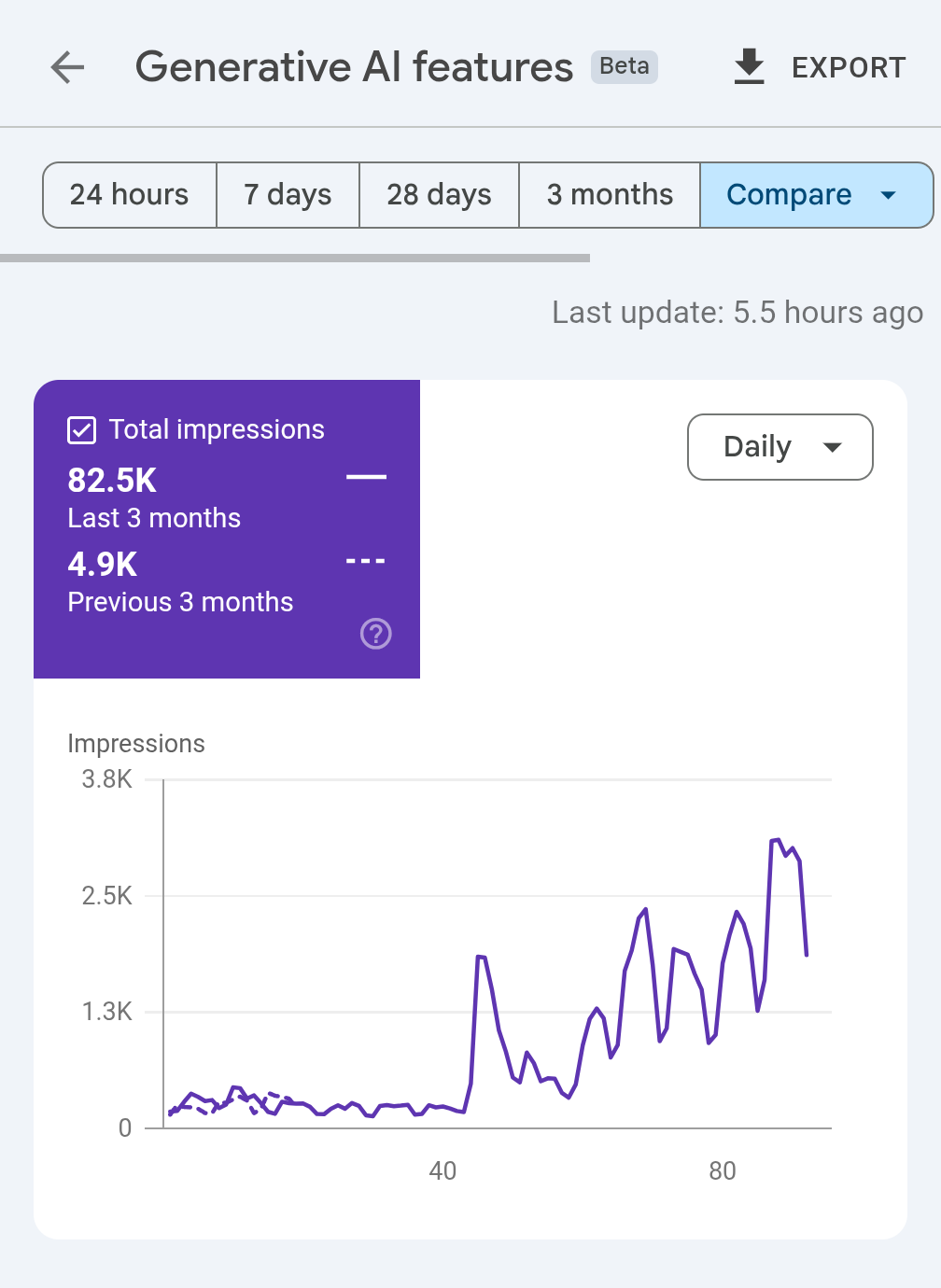
Source: Google Search Console — Generative AI features report, this law firm's own property.
Common AI SEO Mistakes Mississauga Firms Make
The costliest mistake we see is building on sand — layering FAQ content and schema markup on top of a firm whose NAP details don't match across the web, or whose attorney bios carry no checkable credentials. AI systems weigh verification heavily, and no amount of tactical polish fixes a trust problem underneath it.
The second is content that's obviously Toronto's homework with a different city name stapled on. These systems are specifically tuned to spot that pattern and route around it toward something genuinely specific to the market — the exact same thin, generic writing that bores a human reader also fails to earn a citation.
The third is pulling the plug too soon. Schema goes up, a batch of content publishes, citations don't visibly move within four to six weeks, and the firm assumes it isn't working — right as the compounding effect that usually takes several months to show up was about to kick in. AI SEO rewards patience on roughly the same timeline traditional SEO always has.
Pairing AI SEO With an AI-Optimized Website
An AI SEO strategy built on top of a slow, poorly structured website has a ceiling on how effective it can be. This is why AI SEO for Mississauga law firms is designed to work directly alongside AI website design for Mississauga law firms.
If the website is already in good shape, there is no reason to wait — AI SEO can start on its own. Not sure which side needs attention first? The Mississauga AI growth hub breaks down how to tell.
Related Reading: AI SEO Insights
Mississauga Insights: Questions Answered Directly
From My Experience — James Harmiden
One thing that took me a while to fully appreciate about Mississauga is how much its diversity actually matters for search — not as a talking point, but practically. When more than half the city identifies as a visible minority and the South Asian community alone is the largest single group, a lot of the people searching for a lawyer here are doing it in ways a generic SEO playbook was never built to catch: family referrals inside a specific community, searches phrased differently than a textbook keyword list would predict, a first stop on Google Maps because that's genuinely the fastest way to check a firm's reviews and reputation before calling.
I've spent a long time watching firms optimize for one channel and assume the job is done — usually just Google's organic results — while completely missing that a large share of their actual prospective clients are checking Maps first, or asking an AI system a question phrased nothing like what the firm's website was written for. A profile that looks great on paper and a website that ranks fine on Google can still be functionally invisible to how people in a market this diverse actually search.
AI search doesn't close that gap by accident. It closes it if you build for it deliberately — content that actually answers the specific questions being asked, an entity that's consistent and verifiable everywhere, a Google Business Profile that's genuinely maintained rather than claimed and forgotten. That's the work. I'd rather a Mississauga firm hear that from me now than lose ground to a competitor who figured it out first.
— James Harmiden, Founder & CEO, Lexscale.ai