Real results from a law firm engagement, built on the same system we bring to Los Angeles — read the full case study →
A Market Where Polish Is the Baseline, Not the Bonus
A meaningful share of the people evaluating a Los Angeles law firm spend their working lives around genuinely well-built digital products — entertainment-industry professionals used to slick studio and streaming platforms, tech and startup employees comparing everything against a Silicon Beach product, in-house counsel who reviews outside firms for a living. A law firm site that loads slowly or reads like a template stamped out for any small business is a mismatch with that audience before a visitor finishes reading the headline. In a county carrying 64,563 competing attorneys, that mismatch is rarely forgiven with a second look — the tab just closes. See why law firms need AI-optimized websites in 2026 for the fuller picture of why that shift matters.
This page covers what an AI-optimized site actually requires in this specific market, and how it connects to AI SEO for Los Angeles law firms — the part of the equation that determines whether anyone finds the site to begin with.
Template Website vs. AI-Optimized Website
A firm that's spent a decade earning its reputation in this county shouldn't lose the next client to a competitor purely because their site loads a second and a half faster on a phone.
James Harmiden · Founder & CEO, Lexscale.ai
What "AI-Optimized" Actually Means Here
Two audiences read a Los Angeles law firm's website at once, and both need the same thing fast: an AI crawler trying to determine who you are, where you actually practice, and whether to trust you enough to cite, and a person who's already anxious about whatever brought them to the site in the first place. A clever, vague headline serves neither. A page that plainly states what it covers, backed by structured data spelling out the firm's name, practice areas, and actual service area rather than leaving a machine to guess, serves both at once.
Depth matters just as much as clarity, maybe more in a market this contested. The questions actually bringing someone to an LA lawyer right now are specific — a production contract dispute tied to a streaming deal, a car accident on the 405 during a commute between two submarkets, an immigration matter with real deadlines attached. A thin paragraph under a practice-area heading convinces neither the AI system deciding whether to cite the page nor the person deciding whether to call.
Why Load Time Matters More Across 4,084 Square Miles
Every other improvement on a Los Angeles firm's site is undermined if the page itself loads slowly. Core Web Vitals are a direct Google ranking factor on their own, and a slow site gets crawled less often and less thoroughly by the AI systems trying to build a picture of what's actually on it — so a speed problem compounds instead of merely annoying an impatient visitor. In a county this large, where a huge share of legal searches happen from a phone on an inconsistent connection somewhere between the Valley and the Westside, that compounding effect hits harder than it would in a smaller, denser market.
Walk into most older Los Angeles firm sites and you'll find the same story underneath: a decade-old CMS install still dragging around plugins nobody remembers activating and photos nobody ever ran through a compressor. Building on purpose-specific code instead removes that weight at the source, rather than trying to optimize around it — a five-page law firm site has no use for the general-purpose CMS features it inherited anyway. For the full audit checklist, see our guide to law firm website speed and performance.
A Page Structure AI Systems Can Actually Follow
AI systems build their understanding of a site from its structure, not just its sentences — one H1 that states the page's real topic, genuine H2s marking actual sections rather than being sprinkled in for visual rhythm, and internal links connecting related ideas the way a knowledgeable colleague would: a personal-injury page linking to a motor-vehicle-accident FAQ, which links to a settlement calculator. Done well, that turns a website into a topic cluster an AI system can walk through as one coherent body of expertise instead of a stack of disconnected pages competing against tens of thousands of others for attention.
It also means keeping the essentials — firm name, practice areas, actual service area, phone number — in the page's real HTML rather than buried inside JavaScript a crawler might not fully render. Whether a crawler executes your scripts is not a bet worth making with the information a client actually needs to reach you, especially in a market where the alternative firm is one search away. See our guide to law firm website SEO structure for the full breakdown of what that architecture needs to include.
Schema Markup for an LA Law Firm
Structured data is how a page tells search engines and AI systems what's actually on it, in a format they can parse directly instead of inferring from prose. For a Los Angeles firm that typically means LegalService schema describing the firm, Attorney schema for each lawyer with sameAs links to their State Bar of California profile and LinkedIn, FAQPage schema matching whatever's actually visible on the page, and BreadcrumbList schema clarifying how the site is organized.
It's also one of the most consistently skipped pieces of a Los Angeles firm's site, which is exactly why fixing it moves the needle so much in a market carrying this much competition — see our full guide to schema markup for lawyers for the complete picture. Without that structured data, an AI system has nothing solid to check a firm's claims against, no matter how good the surrounding content reads. AI SEO for Los Angeles law firms goes deeper on the visibility side of that same problem.
Designing for Eighty-Eight Different Cities Under One Name
Los Angeles County isn't one market — it's dozens of genuinely distinct submarkets stitched together, and a firm's site needs to reflect that instead of writing as though every visitor is downtown. The Valley, the Westside, South Bay, and the rest each carry different courthouse assignments, different commute patterns, and different day-to-day realities, and a site that speaks plainly to which of those it actually serves does real work a vague "serving all of Los Angeles" line never does.
That same specificity matters for the questions themselves. A car accident on a Westside surface street and a production-contract dispute tied to a Burbank studio are both "Los Angeles legal work," but they come from entirely different corners of this county, and content written generically enough to cover both usually convinces neither reader. The Los Angeles AI growth hub covers more of what makes this county's sprawl a genuinely different content problem than a smaller, denser city.
What California's Rules Mean for Site Copy
This is a real, practical constraint every Los Angeles firm's site has to work within: Rules 7.1 through 7.3 of the California Rules of Professional Conduct govern what a lawyer can claim, how a firm can solicit, and what counts as a false or misleading communication about legal services. Case-result language, comparative claims, and how a firm identifies its own attorneys all sit under real scrutiny — this isn't a soft guideline, it's an enforceable standard.
That means every headline, every bio, every piece of case-result language on a Los Angeles firm's site needs a review pass that specifically checks against Rules 7.1 through 7.3 — not just a general "keep it accurate" pass, but one built around what the Rules actually say. It's an easy thing to get wrong with a generalist writer unfamiliar with California-specific advertising law, and an easy thing to catch with the right process in place from the start.
Mobile Isn't the Backup Experience Here
Most of the legal searches happening in this county right now are happening on a phone — stopped in traffic on the 405, standing in a parking structure right after a hard conversation at work, thumb-typing between errands somewhere in the Valley. A site that was designed for a desktop monitor and is only technically "responsive" on a phone adds friction at the exact moment a visitor has zero patience left for it.
Mobile-first design means the phone number is visible and tappable without hunting, the contact form is short enough to finish with a thumb at a red light, and nothing requires pinching or zooming to read. For a firm competing against tens of thousands of others, this is directly tied to how much of the traffic an SEO strategy earns actually turns into a booked consultation.
Mistakes We See Most Often in This Market
The most common one is content written for anywhere in America that never actually engages with Los Angeles specifics — no reference to the Superior Court of Los Angeles County by name, no acknowledgment of which of its 36 courthouses a matter would run through, nothing that signals real familiarity with the county's size or its submarkets. In a market carrying 64,563 competing attorneys, that generic content is invisible by default. AI SEO for Los Angeles law firms covers what actually needs to replace it.
The second is mismatched contact information — a phone number that's off by a digit between the header and the footer, an address that never got updated after the office moved, a Google Business Profile listing quietly out of sync with the website. Trivial-looking on its own, but it undermines exactly the consistency both Google and AI citation are checking for, and in a county this saturated, that small crack widens fast.
The third is schema markup implemented once and never revisited as the site's content changed around it, so it no longer matches what's actually on the page.
Fourth — and the one most firms don't take seriously enough — is a bare-bones attorney bio. A properly built bio, linked out to a verifiable State Bar of California record, carries more weight for both citation and client confidence than a single page usually gets credit for, especially with tens of thousands of alternative attorneys an AI system could name instead.
What This Actually Returns
The immediate payoff: fewer people bailing on a slow-loading page, more of them actually booking because the contact path is obvious rather than buried, and a technical base solid enough that every dollar spent on SEO afterward stretches further, since the content has somewhere structurally sound to land.
Less directly: durability. A site built on lean, purpose-built infrastructure with real schema markup ages better than a template, because the fundamentals it's built on — speed, clarity, structured data — don't shift even as individual AI platforms and algorithms keep changing underneath it.
And in a market where a prospective client is comparing a firm against tens of thousands of alternatives with zero effort required to check one more, a noticeably faster, clearer site becomes a real, if quiet, reason to pick one firm over another that looks fine on the surface but loads slowly.
Case Study · Law Firm Engagement
From a 140-Page WordPress Site to a 570-Page AI Legal Website
Lexscale.ai transformed this law firm's website from an approximately 140-page WordPress website into an approximately 570-page AI-ready legal website — adding practice-area depth, supporting legal insights, service-area content, legal calculators, interactive guided wizards, structured data, and strategic internal linking, on faster, purpose-built infrastructure.
The result: organic website traffic tripled within 90 days. Results vary by firm, market, and existing authority — but a Los Angeles build follows the identical process, adapted specifically for the county's 88 submarkets and Rules 7.1–7.3 advertising compliance.
Since then, this same law firm's visibility in Google AI Overviews has grown from 4.9K to 82.5K impressions in 3 months — verified directly in Google Search Console.
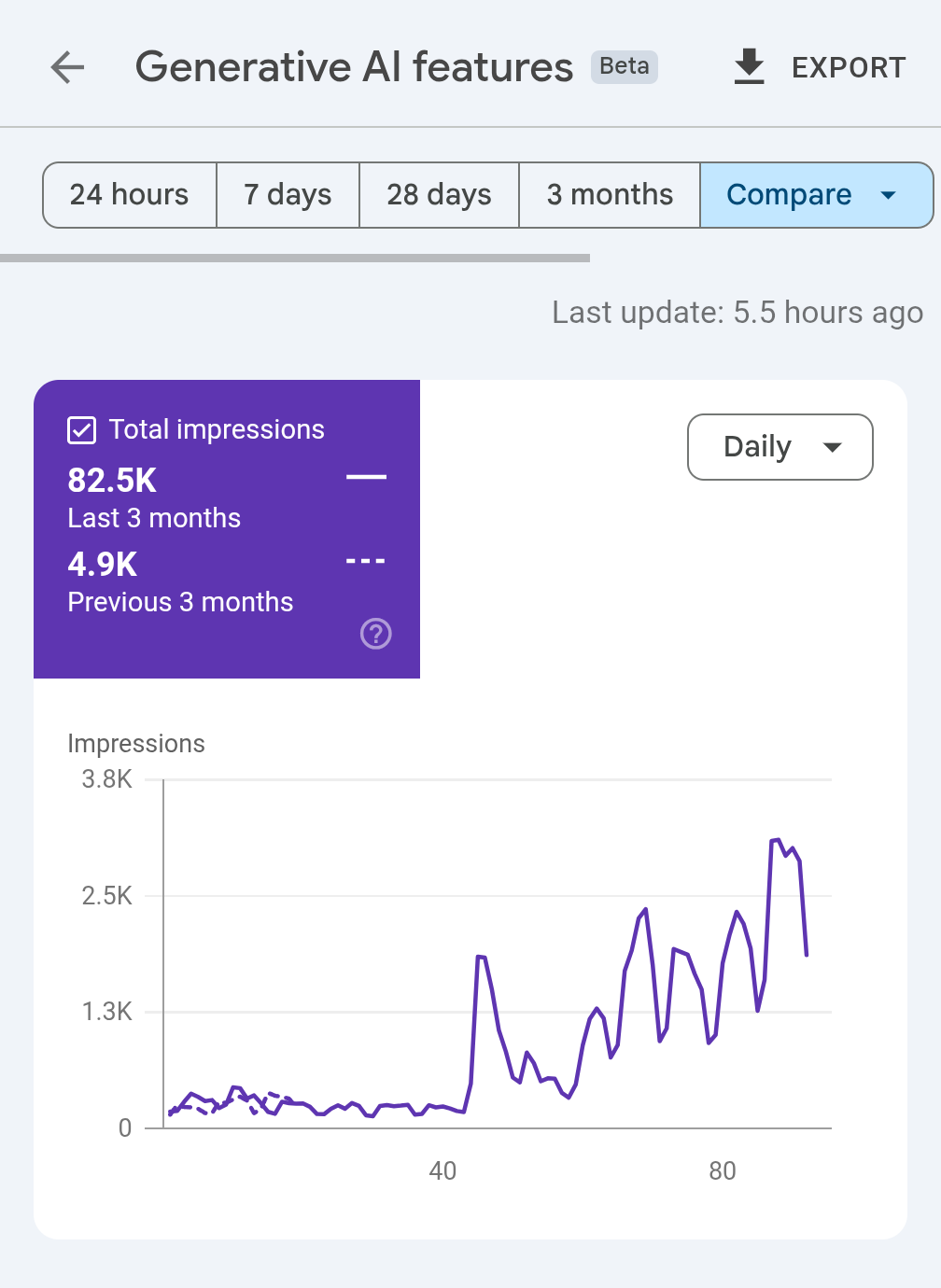
Source: Google Search Console — Generative AI features report, this law firm's own property.
Pairing Your Website With AI SEO for Los Angeles Law Firms
A technically excellent, fast-loading, fully schema-marked site still needs a visibility strategy behind it — otherwise it's simply a well-built site lost among tens of thousands of others. That's the natural next step: AI SEO for Los Angeles law firms, focused specifically on earning citations in Google AI Overviews, ChatGPT, Gemini, and Perplexity for what clients across this county are actually asking.
The two services run on the same technical foundation — schema markup, entity signals, content structure — which is why firms that invest in an AI-optimized website almost always see the strongest results pairing it with a dedicated AI SEO strategy rather than treating visibility as an afterthought in a market this size.
What to Expect in the First 90 Days
With 88 cities and dozens of practice-area combinations in play, the timeline runs the same three phases most builds do, just with more surface area to cover in the first one. Our guide to attorney bio pages that convert covers what the finished bio pages built during that process actually need to include.
Most Los Angeles firms move straight into an ongoing AI SEO engagement after launch, since a freshly built site is exactly when a coordinated visibility push pays off fastest against this much competition.
How the Build Actually Runs
It opens with an audit of what's already live and a strategy call to sort out priorities, then Lexscale.ai handles the design, the build, the schema, and the California-compliant copywriting directly — no outsourced pieces, no generic template dropped in and left to chance. It's the same process behind our broader AI website design work across North America, applied specifically to what a market this size actually needs.
Kickoff call to a live site typically runs a few weeks, and most firms move straight into an AI SEO engagement right after launch rather than treating the new website as the finish line. Want the bigger-picture view before committing to a build specifically? The Los Angeles AI growth hub is the better place to start.
Related Reading: AI Website Design Insights
From My Experience — James Harmiden
The Los Angeles sites I get called in to fix almost always share the same tell: they were built as if the firm's only competition was the office two blocks away. Nobody builds a site that way once they actually sit with the number — 64,563 licensed attorneys in this county alone — because that number makes clear the real competition isn't the office two blocks away. It's every other firm in Los Angeles County an AI system could just as easily decide to name instead of you.
What I keep noticing in this market specifically is how much a site's structure has to work for both a person and a machine at once, and how rarely it actually does. A page written for a Westside entertainment client reads completely differently than one written for a South Bay personal-injury client, and a site that flattens both into the same generic paragraph loses the specificity that would have made either one convincing — to a reader or to whatever AI system is deciding who to cite.
I built the Los Angeles side of this business around one idea: in a county this large, sprawling across 88 cities, a website's job isn't to look impressive in isolation. It's to prove, in a way both a person and an AI system can verify, that this specific firm actually understands the specific corner of the county a specific client is calling about. Do that well here, and you're not just competing — you're one of a genuinely small number of firms an AI system can confidently name.
— James Harmiden, Founder & CEO, Lexscale.ai