Real results from a law firm engagement, built on the same system we bring to Los Angeles — read the full case study →
Keyword Rank Can't Carry a Market This Crowded
Ten blue links and a person scrolling through them was the whole model traditional SEO was built around. That model still exists, but it's no longer the main way most legal questions get answered in this market. Google's AI Overviews now sit above the results themselves on a large share of legal searches, summarizing an answer and naming a short list of sources before a person scrolls any further. ChatGPT and Gemini get asked directly — "who handles wrongful termination cases in LA" or "do I need a lawyer after a car accident on the 405" — and answer with a name already attached, or none at all if nothing available convinced them one was worth naming. Perplexity works the same way, citing sources it judges credible as it builds its answer.
Chasing rank for a handful of keywords in a county with 64,563 competing attorneys is chasing a shrinking share of how people actually find a firm today. AI SEO is the discipline of building the structured data, entity signals, and content depth that gets a firm named inside those AI-written answers instead — and it ties directly into AI website design for Los Angeles law firms, since both run on the same underlying technical work.
Traditional SEO vs. AI SEO
Sixty-four thousand attorneys can all claim they handle personal injury cases in Los Angeles. An AI system deciding who to cite isn't reading the claim — it's checking whether the structure behind it actually holds up.
James Harmiden · Founder & CEO, Lexscale.ai
What Google AI Overviews Are Doing to LA Legal Searches
For a large share of informational legal questions, Google's AI Overview now shows up before the results a person actually scrolled down to see — what counts as comparative negligence in a California car accident, whether a lease needs to disclose something specific to a Los Angeles rental, what a wrongful termination claim actually requires here. A short list of sources sits right under that summary, and a firm named there reaches a prospective client before they've had to scroll past a single competitor.
Earning that citation takes content that answers the exact question head-on and demonstrates real E-E-A-T — experience, expertise, authoritativeness, trustworthiness — none of which a thin, generic page can fake regardless of how precisely it's aimed at a keyword. Content that gets a California-specific detail wrong fares worse than content that's simply vague, because it actively damages the trust signal an AI system is checking for.
Earning a Citation in ChatGPT, Gemini, and Perplexity
ChatGPT, Gemini, and Perplexity each operate on a different underlying mechanism, but they land on the same outcome: naming whichever source they've concluded is directly relevant and trustworthy enough to lean on. For a Los Angeles firm, earning that requires content specific and well-structured enough that these systems attribute the answer to your firm by name — not just list you as one of several sites that touched on the topic in passing.
Attorney bios with real, verifiable credentials, FAQ content matching how people actually phrase a question, and practice-area pages with genuine California statute and Los Angeles County court detail — not paraphrased boilerplate — all move the needle on whether that happens. In a county with 64,563 licensed attorneys, generic content simply doesn't clear the bar these systems are checking against.
Building an Entity Sixty-Four Thousand Competitors Can't Fake
Entity SEO is the practice of making a firm's identity checkable — attorneys, credentials, practice areas, actual service area — so an AI system can confirm those facts on its own instead of taking the homepage's word for it. Against 64,563 other attorneys all making similar claims of experience, that checkability is the actual differentiator.
A ten-page site with airtight, matching entity signals will out-cite a fifty-page site whose NAP data drifts between the footer and its own Google Business Profile listing. Nowhere on this site is that gap more decisive than Los Angeles County: with 64,563 attorneys capable of writing an identical-sounding bio, the signals an AI system can actually verify are the only thing left to tell two "experienced" claims apart.
Treat it as ongoing maintenance, not a one-time launch task. A new hire, a moved office, a merged practice — each of those needs to ripple through the website, its schema, the Google Business Profile listing, and every directory the firm appears in, or the mismatch itself starts working against the firm.
Content That Reflects the Real County, Not a Generic Version of It
Generic American law-firm content doesn't compete here, because it isn't actually about anything specific enough to matter. A real content strategy for a Los Angeles firm builds around what this market's client base is genuinely asking: motor-vehicle accident and personal-injury questions driven by a county this car-dependent and this sprawling, entertainment-industry contract and IP questions tied to the production economy anchoring so much of the local workforce, and immigration questions from one of the largest, most diverse immigrant populations of any metro area in the country.
None of that works if it's just keyword-shaped filler sitting under a heading — it has to hold up when someone actually reads it. Naming the specific courthouse a matter would run through instead of a vague "the courts," being upfront about what varies from one case to the next, giving a realistic sense of timeline rather than a vague promise — those are the specifics that convince a person and an AI system alike, against 64,563 other attorneys repeating the same unsupported claims of experience.
Prioritizing matters more than covering everything at once. A firm doing personal injury, immigration, and business law is usually better off building genuine depth on the one or two areas that actually drive its business first, rather than spreading thin across every practice area in a county this large.
The submarket angle specifically is close to uncontested right now — very few LA firm websites write with any real specificity about which of the county's 88 cities or 36 courthouses they actually serve, which makes that specificity one of the rare ways to build real authority fast in a market this crowded rather than fighting head-on for a generic term. AI website design for Los Angeles law firms covers how that specificity gets built into a site's actual structure.
A Trial Court Sized Like Nothing Else on This Site
The Superior Court of Los Angeles County is the largest single unified trial court system in the United States — more than 10 million residents served across 36 courthouses spread over 4,084 square miles, 88 incorporated cities plus 140 unincorporated areas, close to 600 courtrooms, 583 judicial officers, roughly 4,800 employees, an annual budget north of $1 billion, and something like 1.2 million case filings a year across criminal, civil, family, probate, mental health, and traffic matters. Content that names this court system accurately, and names the specific courthouse relevant to a specific matter, signals real local knowledge in a way generic content about "California courts" never will. The Los Angeles AI growth hub covers more of what makes this legal infrastructure genuinely unlike any other market this site has built for.
Schema and Structured Data, the Non-Negotiables
At minimum, a competitive Los Angeles law firm site needs LegalService or ProfessionalService schema for the firm, Attorney schema for every lawyer, FAQPage schema matching what's actually visible, BreadcrumbList schema on every page, and Article schema on insight content with real publish and modified dates.
This work sits right at the seam between SEO and website architecture, which is why it's covered in depth on both this page and AI website design for Los Angeles law firms.
Google Business Profile Across Eighty-Eight Cities
Google Business Profile still matters for any Los Angeles firm, feeding both classic local search and the newer wave of AI-driven local recommendations — and it carries extra weight in a county this large, because a person searching from the Valley versus the Westside versus South Bay is often looking for the firm closest to their specific courthouse or submarket, not just "a Los Angeles lawyer." Getting the profile right means real categories that match what the firm actually practices, a complete service list, and reviews that keep coming in rather than a burst of five from the launch month.
GBP data also feeds straight into the entity confidence AI systems rely on when deciding whether to cite a source — matching it against your website's schema is one of the simplest, highest-leverage checks most Los Angeles firms have never actually run.
Backlinks in a City Built on Media and Production
Backlinks haven't stopped mattering — they've gotten pickier about which ones count. Being quoted by a publication a reader would actually recognize still moves both a traditional ranking and an AI system's confidence in citing a firm; a paid slot on a directory nobody reads doesn't. In Los Angeles, that respected-source list runs toward entertainment-trade press, local business coverage, and industry-group mentions earned by actually commenting publicly on production, media, or employment-law questions.
The old playbook — stack up as many directory citations as possible — is largely priced out at this point; current algorithms have gotten good at recognizing that pattern and discounting it accordingly. One real mention in an outlet the local legal or entertainment community actually reads outweighs a hundred of those directory listings combined.
The county's density of production companies, studios, and independent creators also opens a specific, underused angle: relationships built through entertainment-industry associations, guild referral networks, and startup accelerators around the tech corridor can produce genuine referral links that a smaller market simply doesn't have the density to support.
What California's Rules Mean for AI-Assisted Content
Any Los Angeles firm using AI tools to help draft content needs a review step between generation and publication — and California's Rules 7.1 through 7.3 add a wrinkle a generic AI writing tool won't catch on its own: what counts as a false or misleading claim, a prohibited comparison, or an improper solicitation is specific enough that a general-purpose content tool trained on marketing copy from other industries won't reliably flag it.
In practice that means every piece of AI-assisted content gets checked against Rules 7.1 through 7.3 before it goes live, the same way a firm would review a junior associate's first draft before it left the building.
What's Actually Worth Measuring
Standard rank-tracking tools don't know what to do with an AI citation, because there's usually no clean, clickable link to log — the mention just sits inside a generated answer. What actually tells you something instead: running priority queries through ChatGPT, Gemini, and Perplexity by hand to see whether the firm gets named, watching which searches trigger an AI Overview mention, tracking branded and direct traffic as a downstream proxy, and paying attention the first time a new client says an AI tool is how they found you.
Check this monthly, not quarterly — both AI-driven and traditional visibility bounce around week to week even when the real trend is heading in the right direction, and any firm vetting an AI SEO partner in a market this competitive should ask, specifically, how they're going to track and report citations before signing anything. The Los Angeles AI growth hub lays out what a full engagement actually looks like end to end.
Case Study · Law Firm Engagement
From a 140-Page WordPress Site to a 570-Page AI Legal Website
Lexscale.ai transformed this law firm's website from an approximately 140-page WordPress website into an approximately 570-page AI-ready legal website — adding practice-area depth, supporting legal insights, service-area content, legal calculators, interactive guided wizards, structured data, and strategic internal linking, on faster, purpose-built infrastructure.
The result: organic website traffic tripled within 90 days. Results vary by firm, market, and existing authority — but a Los Angeles AI SEO engagement follows the identical process, adapted specifically for the county's 88 submarkets and Rules 7.1–7.3 advertising compliance.
Since then, this same law firm's visibility in Google AI Overviews has grown from 4.9K to 82.5K impressions in 3 months — verified directly in Google Search Console.
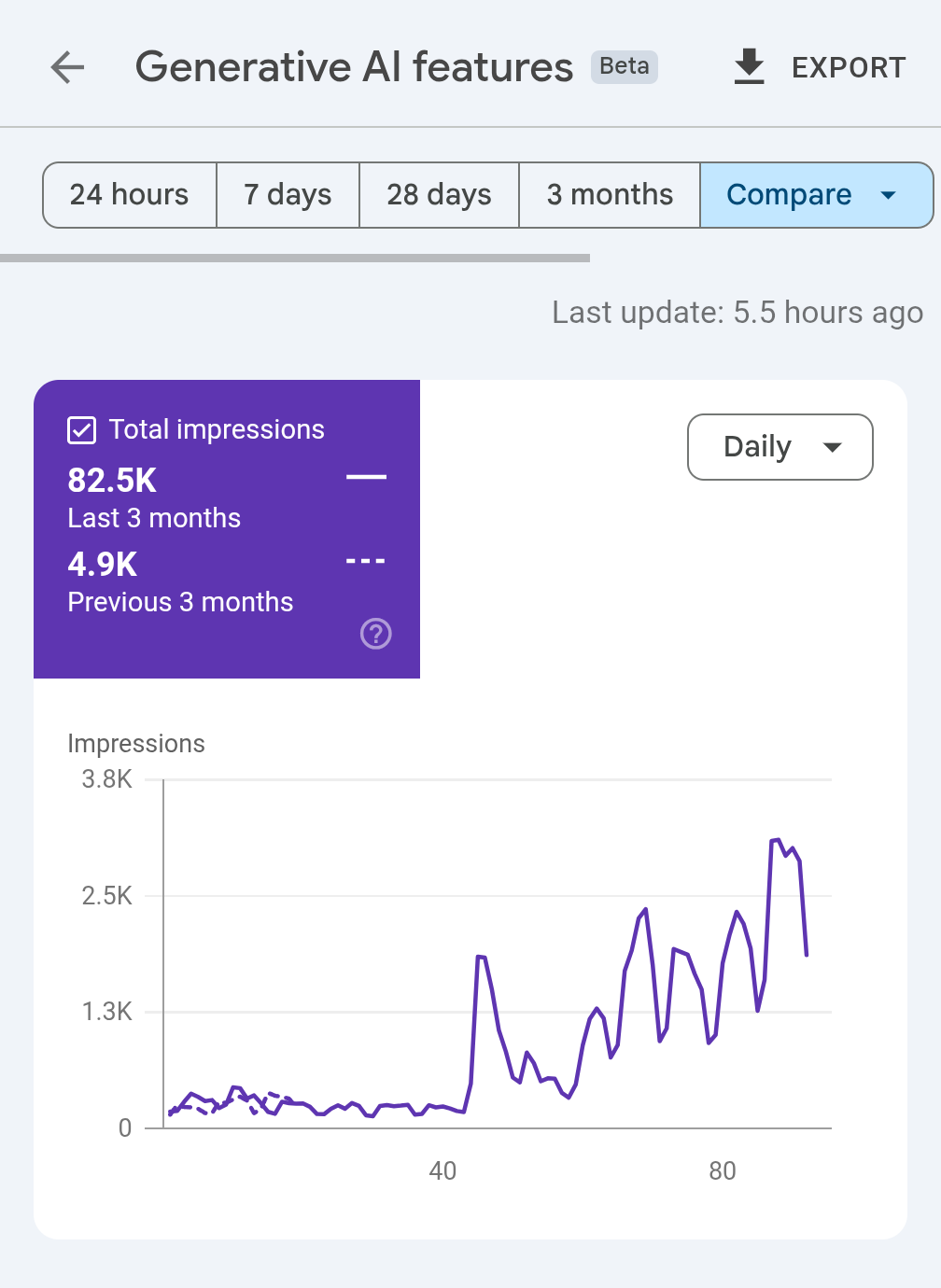
Source: Google Search Console — Generative AI features report, this law firm's own property.
Where Los Angeles Firms Waste the Most Effort
The expensive mistake is building tactics on a foundation that was never actually poured — publishing schema and FAQ content while the firm's phone number still doesn't match between the site and its own Google listing, or a bio page with a name and nothing verifiable underneath it. Against 64,563 competing attorneys, AI systems lean hard on trust signals, and no amount of tactical polish rescues a base that isn't solid; when that's the real gap, AI website design for Los Angeles law firms fixes it faster than piling on more SEO work would.
Second is publishing content that could describe a firm in any American city — no reference to the Superior Court of Los Angeles County, no acknowledgment of the county's actual submarkets, nothing California-specific — which AI systems are increasingly good at spotting and quietly ranking below content that actually demonstrates it knows the market.
Third is patience running out too early. AI SEO compounds the same way traditional SEO always has — slowly at first — and in a county this saturated, that slow start stretches out longer than it would somewhere smaller. Firms that ship schema and a handful of strong pages, see nothing dramatic after a month or two, and pull the plug are almost always quitting the exact week before the compounding actually kicks in.
The Website Underneath the Strategy Has to Hold Up
Pour an SEO strategy onto a site that's slow or structurally weak and there's a hard ceiling on what it can achieve in a market this size, no matter how good the content is. That's why this page is built to run alongside AI website design for Los Angeles law firms, not as a bolt-on to whatever site a firm already happens to have.
A site that's already fast and well-structured doesn't need to wait on anything — go straight to the SEO work. Unsure which gap is actually costing your firm clients? The Los Angeles AI growth hub has the checklist to figure that out first.
Related Reading: AI SEO Insights
From My Experience — James Harmiden
The number that changed how I think about SEO in this market isn't a ranking metric at all. It's 64,563 — the count of licensed attorneys in LA County alone. I've sat with firms in plenty of markets who worried about "the competition" in the abstract. In Los Angeles, the competition has an actual headcount, and it's larger than the entire attorney population of most states combined. You cannot out-keyword a number that size. You can only out-verify it.
What that means in practice is that I spend less time in this market talking about content volume and more time talking about specificity — does this page name the actual courthouse a case runs through, does this bio link somewhere an AI system can independently check, does this firm's content acknowledge that "Los Angeles" is really eighty-eight different cities wearing one name. Almost none of the 64,563 do this well. That gap is the entire opportunity.
I've also learned to take this county's industries seriously as content categories, not footnotes. Entertainment-industry legal questions and a genuinely enormous immigrant population's legal questions aren't niche corners of this market — they're a meaningful share of what's actually being searched here, and most firm websites still write as if neither exists. Build for what this county actually is, not a generic version of it, and you stop competing against 64,563 attorneys and start being one of the handful an AI system can confidently name.
— James Harmiden, Founder & CEO, Lexscale.ai