Real results from a Toronto law firm engagement — read the full case study →
Why Traditional SEO Isn't Enough for Toronto Law Firms Anymore
Traditional SEO — backlinks, keyword density, domain authority — still matters, but it was built for a search landscape where a person typed a phrase into Google and scrolled through ten blue links. That is no longer the only, or even the primary, way many prospective clients in Toronto research a legal problem. Google AI Overviews, ChatGPT, Gemini, and Perplexity now frequently answer a legal question directly, citing a small number of sources they trust, before a user ever reaches a traditional results page.
For a Toronto firm, this means a strategy built purely around ranking for "personal injury lawyer Toronto" or "family lawyer GTA" is optimizing for a shrinking share of how clients actually find a firm. AI SEO is the practice of building the structured data, entity signals, and content depth that get a firm cited inside AI-generated answers — a fundamentally different (though related) discipline from traditional keyword ranking, and the core focus of this page. It connects directly to AI website design for Toronto law firms, since the technical foundation both disciplines depend on is the same.
Traditional SEO vs. AI SEO
SEO isn't about fooling Google anymore. It's about giving AI systems enough verified structure to trust you by name — especially in a market as crowded as Toronto.
James Harmiden · Founder & CEO, Lexscale.ai
How Google AI Overviews Are Reshaping Toronto Legal Searches
Google AI Overviews now appear above traditional results for a large share of informational legal queries — "what to do after a car accident in Ontario," "how long does probate take in Toronto," "can my landlord evict me without notice." These synthesized answers cite a handful of sources directly beneath the summary, and appearing in that citation list puts a Toronto firm in front of a prospective client before they've even scrolled to a traditional result.
Being cited in an AI Overview requires content that directly and specifically answers the query, backed by clear E-E-A-T signals — experience, expertise, authoritativeness, and trustworthiness. Generic, thin content rarely gets cited, regardless of how well it targets a keyword phrase. This is why AI SEO leans so heavily on genuinely substantive, specific content rather than the keyword-density tactics that used to work for traditional rankings.
Getting Cited in ChatGPT and Perplexity as a Toronto Firm
ChatGPT and Perplexity work differently from Google's AI Overviews, but the underlying principle is similar: they cite sources they've identified as authoritative and directly relevant to the question asked. For a Toronto law firm, this means the content published across your website needs to be structured and specific enough that these systems can confidently attribute an answer to your firm — not simply mention you exist.
Attorney bios with genuine credentials and sameAs links to verifiable external profiles, FAQ content matching real client questions with FAQPage schema, and practice-area pages with jurisdiction-specific detail about Ontario law all meaningfully increase the odds of citation. Firms that treat this content as a checkbox rather than a genuine knowledge asset consistently underperform firms that invest in real depth, regardless of overall site size.
Entity SEO: Building Authority Signals AI Systems Trust
Entity SEO is the practice of building a clear, verifiable, cross-referenced digital identity for your firm and its lawyers — one that AI systems and search engines can confirm rather than merely infer.
This cross-referencing is exactly how AI systems build confidence that an entity is real, verified, and trustworthy enough to cite. A firm with strong entity signals but a smaller content library will frequently outperform a firm with more content but weak, inconsistent entity signals, because AI citation depends heavily on trust confirmation, not just topical relevance.
Building entity authority is not a one-time task. As a Toronto firm adds lawyers, changes practice focus, or updates its address, every one of those changes needs to propagate consistently across the website, schema markup, GBP listing, and any legal directories the firm is listed in. Firms that treat entity consistency as an ongoing maintenance discipline — rather than a launch-day checklist — tend to build and keep the strongest AI citation performance over time.
Content Strategy for a Competitive Legal Market
Toronto's legal market is dense enough that thin, generic content simply does not compete. An effective AI SEO content strategy for a Toronto firm is built around topical clusters — a strong pillar page for each practice area, supported by multiple in-depth articles addressing the specific questions clients ask at each stage of their situation, all linked together clearly. This structure signals topical authority to both traditional search algorithms and AI citation systems in a way that isolated, unconnected pages never can.
Content also needs to be genuinely useful, not written purely to satisfy a keyword target. Realistic timelines, honest caveats about outcomes, specific references to Ontario statutes and processes, and content that reads like it was written by someone who actually practices in this area all meaningfully increase both citation likelihood and client trust once they land on the page.
Prioritization matters too. Rather than attempting to build every possible practice area cluster simultaneously, the strongest results usually come from picking the one or two practice areas that represent the highest-value client work for a given Toronto firm and building genuine depth there first, before expanding coverage — a concentrated cluster of fifteen strong pages consistently outperforms thirty scattered, shallow ones.
Schema Markup and Structured Data Essentials
Schema markup is the backbone of AI SEO. At minimum, a competitive Toronto law firm website needs LegalService or ProfessionalService schema describing the firm itself, Attorney or Person schema for each lawyer, FAQPage schema matching visible FAQ content exactly, BreadcrumbList schema on every page, and Article schema on insight content with accurate publish and modified dates.
This is technical work that lives at the intersection of SEO and website architecture, which is why it is covered in depth on both this page and AI website design for Toronto law firms. Firms that treat schema as a one-time setup rather than an ongoing maintenance item tend to see it degrade over time as content changes without the structured data being kept in sync.
Google Business Profile Optimization for the GTA
Google Business Profile remains a critical visibility surface for any Toronto firm, feeding both traditional local search results and increasingly AI-driven local recommendations. A fully optimized profile includes accurate, consistent categories matching your actual practice areas, complete service and attribute listings, a steady cadence of genuine client reviews, and prompt, substantive responses to every review received.
GBP data also feeds directly into the entity confidence AI systems use when deciding whether to cite a firm — consistency between your GBP listing and your website's schema markup is one of the simplest, highest-leverage fixes most Toronto firms have never audited.
The Q&A section of a Google Business Profile is also worth active management rather than being left unattended. Proactively seeding accurate, helpful answers to the questions prospective clients most commonly ask — rather than leaving the section empty or, worse, letting an inaccurate crowd-sourced answer stand uncorrected — is a small but consistent signal of an actively maintained, trustworthy listing.
Digital PR and Backlinks in the Toronto Legal Community
Backlinks from genuinely relevant, authoritative sources remain a meaningful signal for both traditional SEO and AI citation confidence. For a Toronto firm, this typically means contributions to legal publications, guest commentary in local business or legal press, speaking engagements referenced online, and relationships with referral partners who link back to your site. Generic, low-quality directory backlinks — once a staple of local SEO — carry little to no weight in an AI SEO strategy and are frequently ignored or discounted entirely by modern algorithms.
Digital PR built around genuine expertise — commenting authoritatively on a legal development relevant to Ontario, publishing original data or case-outcome analysis — tends to earn both the kind of backlinks that move rankings and the kind of citation-worthy authority that gets referenced directly by AI systems answering related questions. A single well-placed feature in a respected legal or business publication typically outweighs dozens of low-quality directory listings, both in traditional ranking impact and in the entity credibility it lends a Toronto firm in the eyes of an AI system evaluating whether to cite it.
Law Society of Ontario Compliance for AI-Generated Content
Any Toronto firm using AI tools to help produce content needs a compliance layer between generation and publication. The Law Society of Ontario's advertising rules apply regardless of whether a human or an AI tool drafted the initial copy — claims still need to be accurate and verifiable, outcomes still cannot be guaranteed, and any automated system interacting with prospective clients still needs appropriate disclosure. AI-assisted content production can meaningfully speed up a Toronto firm's content strategy, but only when paired with review processes built specifically around these standards.
In practice, this means every piece of AI-assisted content — a new practice-area page, an FAQ answer, a blog article — passes through a review step that checks it against LSO advertising standards before publication, the same way a firm would review copy drafted by a junior associate or an outside marketing writer. Treating AI as a drafting tool that still requires professional review, rather than a fully autonomous publishing system, keeps a Toronto firm's content strategy both fast and compliant.
Measuring AI SEO Success: What to Track
AI SEO requires a different measurement approach than traditional SEO, since citation inside an AI-generated answer doesn't always produce a clickable, trackable link the way a traditional search result does. Meaningful metrics include tracking specific query citations manually across ChatGPT, Gemini, and Perplexity for your target practice areas, monitoring appearance in Google AI Overviews for priority queries, tracking direct and branded search traffic growth (a common downstream effect of AI citation), and monitoring consultation requests that mention finding the firm through an AI tool.
This is a newer measurement discipline than traditional rank tracking, and any Toronto firm evaluating an AI SEO partner should ask specifically how citation and visibility are tracked and reported — vague promises about "AI optimization" without a concrete measurement plan are a warning sign. Reporting cadence matters too: monthly reviews that show trend direction across these metrics are far more useful than a single point-in-time snapshot, since both traditional and AI-driven visibility naturally fluctuate week to week even when the underlying trend is positive.
Case Study · Toronto Law Firm
From a 140-Page WordPress Site to a 570-Page AI Legal Website
Lexscale.ai transformed this law firm's website from an approximately 140-page WordPress website into an approximately 570-page AI-ready legal website — adding practice-area depth, supporting legal insights, Toronto and GTA service content, legal calculators, interactive guided wizards, structured data, and strategic internal linking, on faster, purpose-built infrastructure.
The result: organic website traffic tripled within 90 days. Results vary by firm depending on competition, market, and existing authority — but this is the kind of outcome a properly structured AI SEO strategy can make possible.
Since then, this same law firm's visibility in Google AI Overviews has grown from 4.9K to 82.5K impressions in 3 months — verified directly in Google Search Console.
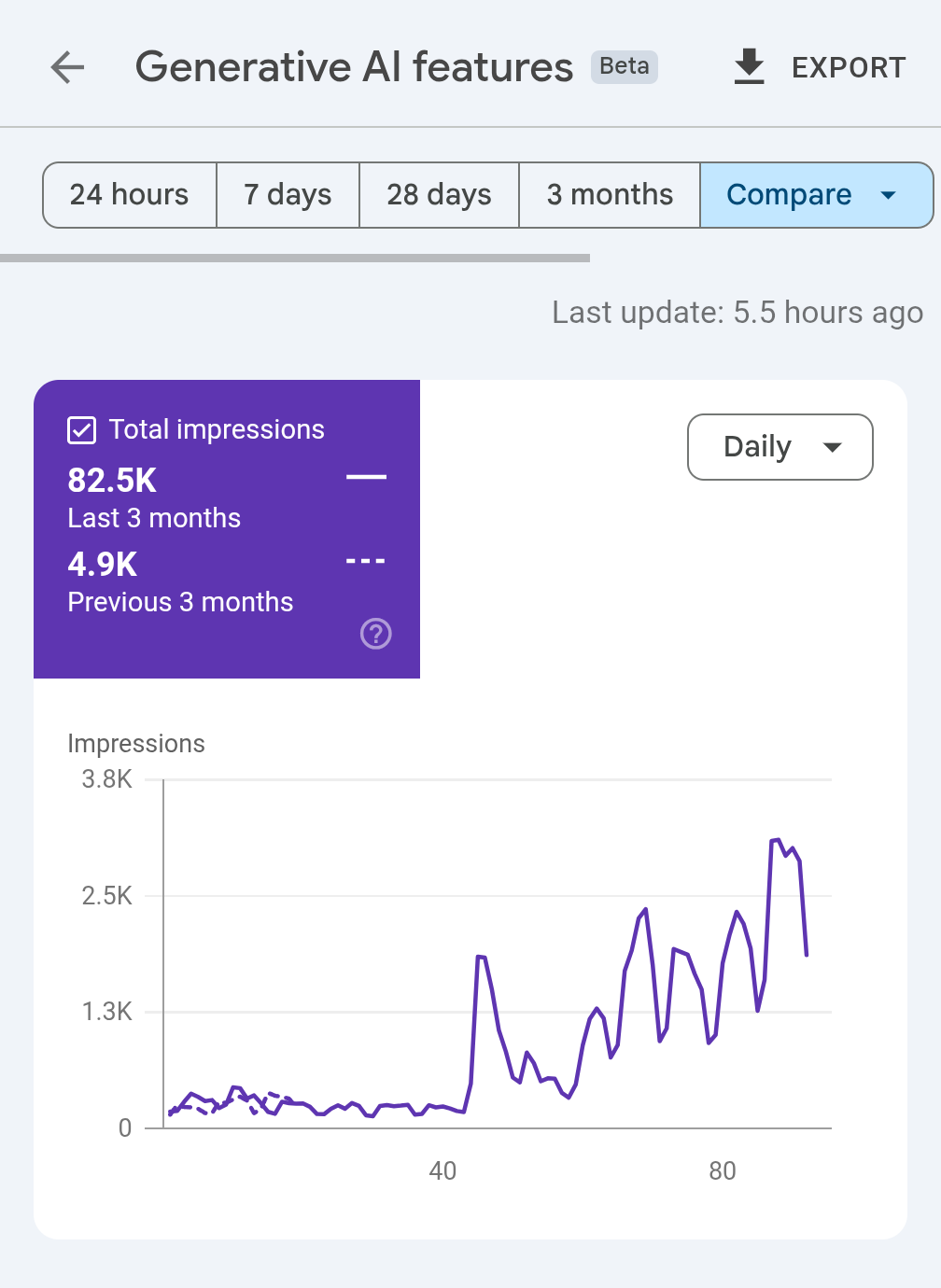
Source: Google Search Console — Generative AI features report, this law firm's own property.
Common AI SEO Mistakes Toronto Firms Make
The most damaging mistake is chasing AI SEO tactics without the entity foundation to support them — publishing FAQ content and adding schema markup while the firm's NAP information is inconsistent across the web, or while attorney bios contain no verifiable credentials. AI systems weigh trust and verification heavily; tactics layered on top of a weak trust foundation rarely produce the citation results a firm expects.
A second common mistake is outsourcing content production entirely to generic AI writing tools without legal-industry review, producing pages that read as vague and interchangeable with thousands of other law firm websites. AI systems are specifically built to recognize and deprioritize this kind of generic content in favor of sources demonstrating genuine, specific expertise — which means unreviewed AI-generated content can actively work against a Toronto firm's citation goals rather than helping them.
A third mistake is abandoning a strategy too early. AI SEO, like traditional SEO, compounds over months rather than producing results overnight. Firms that implement schema markup and a handful of content pieces, see no immediate citation increase, and abandon the strategy within 60 days are giving up before the compounding effect that typically emerges over a longer horizon has a chance to take hold.
What a Toronto AI SEO Engagement Includes
A complete AI SEO engagement for a Toronto firm typically starts with a full audit — current schema implementation, entity consistency across the web, existing content depth by practice area, and a baseline citation check across ChatGPT, Gemini, and Perplexity for priority queries. From there, the work splits into technical implementation (schema markup, structured data, entity consistency fixes) and content strategy (topical clusters, FAQ development, practice-area depth), executed on an ongoing basis rather than as a single one-time project.
Reporting typically covers citation tracking across AI platforms, AI Overview appearance for priority queries, organic and branded traffic trends, and consultation volume — giving a Toronto firm a clear, concrete view of what the strategy is actually producing rather than vague visibility claims.
Pairing AI SEO With an AI-Optimized Website
An AI SEO strategy built on top of a slow, poorly structured website has a ceiling on how effective it can be — the technical foundation matters as much as the content and citation strategy sitting on top of it. This is why AI SEO for Toronto law firms is designed to work directly alongside AI website design for Toronto law firms, rather than as an isolated service layered onto whatever website a firm already has.
Firms starting from an already well-built website can begin directly with AI SEO. Firms whose website needs foundational work first typically see stronger, faster results by addressing the website alongside — or just ahead of — the SEO strategy. The Toronto AI growth hub walks through how to decide which starting point fits your firm.
Related Reading: AI SEO Insights
Toronto SEO Insights: Questions Answered Directly
From My Experience — James Harmiden
For most of my career, "SEO" for a law firm meant one thing: rank on Google. I spent years chasing that single scoreboard for firms across the GTA. That scoreboard doesn't exist anymore — not as the only one that matters.
Today a Toronto client might find their next lawyer three different ways in the same week: a Google Maps search from their phone in the middle of a stressful afternoon, a direct Google search that used to be the whole game, or a question typed into ChatGPT or Perplexity that never touches a traditional results page at all. I've watched firms nail one of those three and completely ignore the other two, and it costs them constantly — a firm with a beautifully optimized Google Business Profile and zero presence in AI search is invisible to an entire generation of people who now ask a chatbot before they ever open Google.
I built the SEO side of Lexscale.ai to cover all three surfaces at once, because that's genuinely how people search now, whether or not the marketing industry has caught up to it. AI is the future of this. The firms that get found across all of it — Maps, Google, and AI search — are the ones booking the consultations five years from now.
— James Harmiden, Founder & CEO, Lexscale.ai