Real results from a Toronto law firm engagement, built on the same system we bring to Ottawa — read the full case study →
Why Traditional SEO Isn't Enough for Ottawa Law Firms Anymore
Traditional SEO was built around a simple goal: rank as high as possible in Google's ten blue links. That goal hasn't disappeared, but it's no longer the whole picture. Google's AI Overviews now answer a large share of legal questions directly at the top of the results page, and ChatGPT, Gemini, and Perplexity increasingly function as a first stop entirely outside Google — a federal employee researching a workforce reduction, or a Kanata tech worker researching a non-compete clause, is as likely to ask an AI system directly as to type a search into Google.
AI SEO is the practice of optimizing specifically for that shift: building the structured data, entity signals, and content depth that get an Ottawa firm cited inside an AI-generated answer, not just ranked on a traditional results page. This is a fundamentally different — though related — discipline from traditional SEO, and it connects directly to AI website design for Ottawa law firms, since the technical foundation both disciplines depend on is the same.
Traditional SEO vs. AI SEO
The Federal Employment Opportunity Most Ottawa Firms Are Missing
No practice area illustrates the AI SEO opportunity in Ottawa as clearly as federal employment law. With roughly 146,000 federal public service employees across Ottawa-Gatineau — the largest concentration of federal workers anywhere in Canada — and tens of thousands of positions cut over the past two years amid continued workforce reductions, the volume of real, specific legal questions this generates is substantial: grievance processes, disability and pension implications, workforce adjustment rights, and union representation questions.
Most Ottawa employment firms have generic "employment law" pages that never mention the federal public service specifically, which means they're invisible when an AI system is asked a federal-employment-specific question. A firm that builds genuine, detailed content around this exact client base — how the federal grievance process actually works, what workforce adjustment entitles an employee to, how pension implications differ by department — has a real, current opportunity to become the cited authority before more competitors catch on.
How Google AI Overviews Are Reshaping Ottawa Legal Searches
The shift is visible in the questions themselves. Where a prospective client used to type "family lawyer Ottawa" and scroll ten results, they're now more likely to ask something conversational and specific — "what happens to custody if one parent relocates from Ottawa to Gatineau for work" — and expect a direct answer, not a list to sort through. Google's AI Overviews now sit above the traditional results for a large share of these informational legal queries, citing a handful of sources directly beneath the synthesized answer, and landing in that citation list puts an Ottawa firm in front of a client before they've even scrolled to a traditional result.
Earning that placement takes content that answers the actual question head-on and demonstrates real E-E-A-T — experience, expertise, authoritativeness, and trustworthiness — not a page tuned for a keyword phrase. A generic "family law" page says nothing an AI Overview can confidently cite; a page that correctly walks through what an Ontario-Quebec custody relocation actually involves does. ChatGPT and Gemini work the same way underneath, reaching for whichever source they've already decided is authoritative and squarely on-topic for the question being asked.
Ranking first in Google no longer covers the whole job for an Ottawa firm. The real target is becoming the source these systems reach for on the questions this market actually generates — federal employment rights, cross-border Ontario-Quebec family and property matters, what closing on a new build in Barrhaven or Orleans actually involves. Getting there takes structured data, clear entity signals, and content built around the specific questions Ottawa clients are asking, not a rewritten version of a generic Canadian legal FAQ.
Kanata's Tech Sector: A Second Underserved SEO Opportunity
Kanata North is Canada's largest technology park — more than 500 companies and roughly 33,000 employees working in telecom, networking, and autonomous-vehicle technology, anchored by employers like Nokia, Ciena, Mitel, and BlackBerry QNX. Roughly three-quarters of the companies in the park employ fewer than 50 people, which means most of them have no in-house legal counsel and rely entirely on outside firms for employment agreements, IP matters, and commercial disputes.
Very little Ottawa legal content speaks directly to this client base. A firm that builds genuine, specific content around the employment and commercial questions a growing Kanata tech company actually asks — equity compensation, non-compete enforceability in Ontario, IP assignment on termination — is addressing a real, currently underserved segment of the Ottawa legal market with almost no dedicated competing content to outrank.
The Ontario-Quebec Border: A Genuinely Unique Ottawa SEO Opportunity
Ottawa sits directly across the river from Gatineau, Quebec — meaning the National Capital Region spans two entirely different legal systems, Ontario common law and Quebec civil law, within a single metro area and often a single client base. This is a content opportunity no Toronto, Mississauga, or Vancouver firm can replicate: genuine, accurate content explaining what it means for an Ottawa client when a matter touches Quebec — property purchased in Gatineau, a family living across the interprovincial border, a business operating in both provinces.
AI systems specifically reward this kind of precise, jurisdiction-aware content because it demonstrates exactly the specificity that separates a genuine authority from a generic legal content mill. An Ottawa firm that builds this content correctly — and clearly, honestly scopes what it can and can't advise on across the provincial line — has a durable, differentiated SEO advantage that's structurally impossible for firms outside the National Capital Region to compete with.
No other Canadian legal market sits on a provincial border the way Ottawa does. That's not a complication to work around — it's one of the clearest, most defensible content advantages available to a firm willing to build it properly.
James Harmiden · Founder & CEO, Lexscale.ai
Case Study · Toronto Law Firm
From a 140-Page WordPress Site to a 570-Page AI Legal Website
This is a Toronto engagement, not an Ottawa one — we don't yet have a published National Capital Region case study — but it's the same system we'd bring to an Ottawa firm. Lexscale.ai transformed this law firm's website from an approximately 140-page WordPress website into an approximately 570-page AI-ready legal website, adding practice-area depth, supporting legal insights, service-area content, legal calculators, interactive guided wizards, structured data, and strategic internal linking, on faster, purpose-built infrastructure.
The result: organic website traffic tripled within 90 days. Results vary by firm, market, and existing authority — but an Ottawa AI SEO engagement follows the identical process, adapted for genuine bilingual EN/FR support and Law Society of Ontario compliance.
Since then, this same law firm's visibility in Google AI Overviews has grown from 4.9K to 82.5K impressions in 3 months — verified directly in Google Search Console.
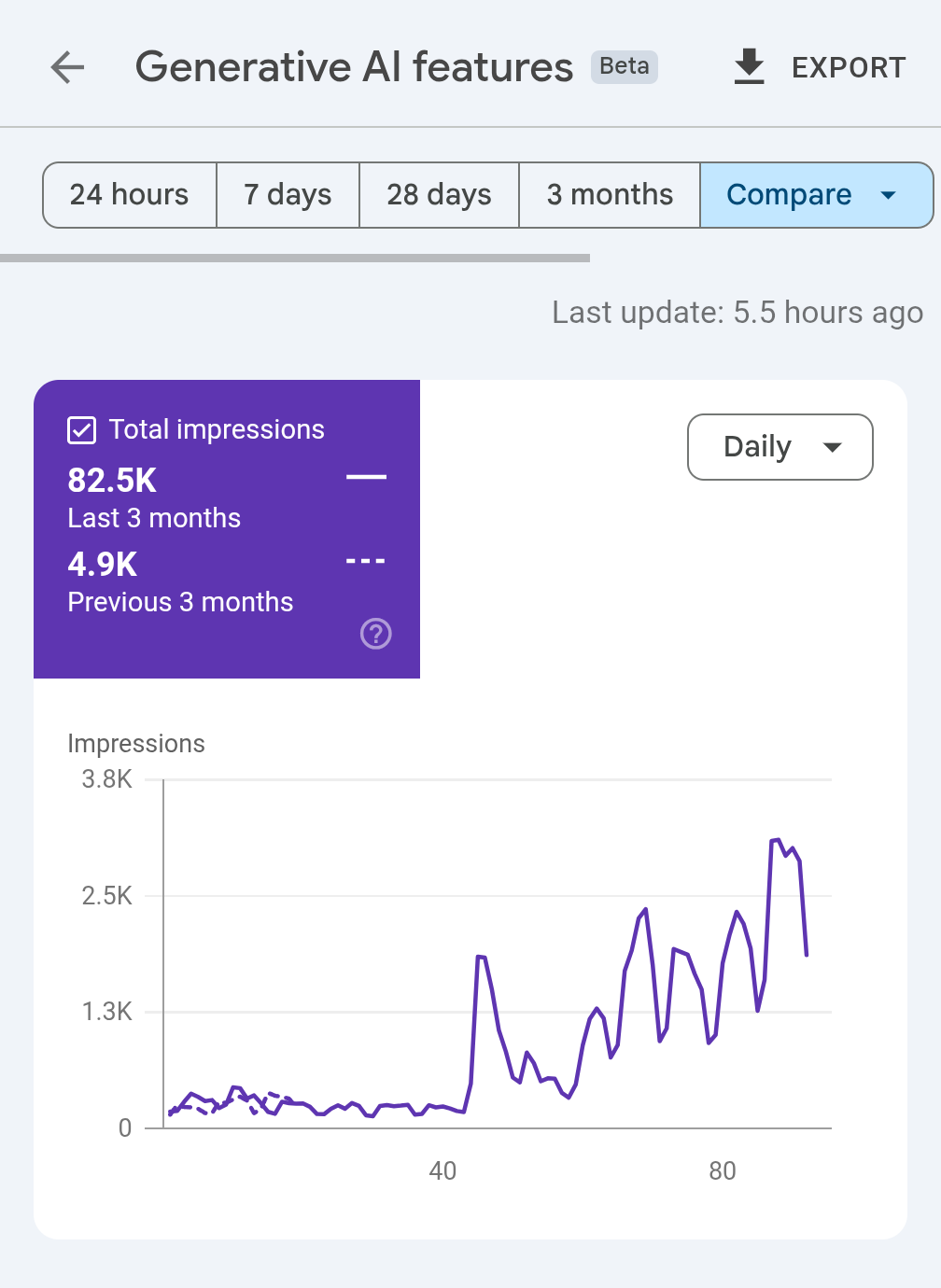
Source: Google Search Console — Generative AI features report, this law firm's own property.
Common AI Search Mistakes Ottawa Law Firms Make
The most common mistake is treating Ottawa as generic Ontario content with the city name inserted, ignoring the federal employment base, the bilingual client population, and the interprovincial dynamic that make this market genuinely distinct. AI systems increasingly reward — and cite — content that reads like it was written by someone who actually understands the subject and the market, not a template filled in with local search volume in mind.
The second common mistake is publishing English-only content in a market that's been officially bilingual since 2001. A firm that ignores French-speaking prospective clients — particularly concentrated in Ottawa's east end — is invisible to a meaningful, underserved segment of the market that most competitors have also ignored, which makes it a genuine, low-competition opportunity rather than just a compliance nicety.
The third mistake is inconsistency between a firm's website, Google Business Profile, and other listings, especially around bilingual service claims. AI systems and Google's algorithms both cross-reference these signals to build confidence in an entity — a firm claiming French-language service on its website but showing an English-only Google Business Profile sends a confusing signal that works against citation See Google Business Profile for Ottawa law firms for the full breakdown of category, review, and bilingual-listing best practices.
What a Complete Ottawa AI SEO Engagement Includes
A complete AI SEO engagement for an Ottawa firm typically starts with a full audit — current schema implementation, entity consistency across the web, existing content depth by practice area (including any federal-employment or bilingual gaps), and a baseline citation check across ChatGPT, Gemini, and Perplexity for priority queries. From there, the work splits into technical implementation (schema markup, structured data, entity consistency, hreflang tags for bilingual content) and content strategy (topical clusters, FAQ development, federal-employment and Ottawa-Gatineau-specific depth), executed on an ongoing basis.
Reporting typically covers citation tracking across AI platforms, AI Overview appearance for priority queries, organic and branded traffic trends, and consultation volume — giving an Ottawa firm a clear, concrete view of what the strategy is actually producing.
Pairing AI SEO With an AI-Optimized Website
An AI SEO strategy layered onto a slow, poorly structured, or English-only website has a ceiling on how far it can go — which is why this service is built to run alongside AI website design for Ottawa law firms rather than as something bolted onto whatever site a firm happens to have.
A firm whose site is already fast and well-structured can go straight into AI SEO. A firm whose site needs work first usually gets to strong results faster by running both at once rather than sequencing them — the Ottawa AI growth hub walks through how to tell which situation you're in.
Putting a Number on AI Visibility for an Ottawa Firm
Think about what a single AI-generated recommendation is actually worth to a mid-sized Ottawa employment or family practice. It reaches someone at the exact moment they're deciding who to call — and it reaches them because a system they already trust judged your firm to be the right answer, not because you outbid a competitor for ad placement. That's a meaningfully different kind of trust than anything a paid campaign buys.
That trust compounds over time. Ottawa is projected to be Ontario's fastest-growing census division through 2051, and federal workforce reductions alone keep producing new grievance, pension, and disability questions every quarter. The more consistently an AI system cites your firm as the reliable source on a topic, the more it defaults back to that source the next time a related question comes up — which is exactly why firms investing in this now are pulling ahead of the ones still treating it as optional.
Ottawa's Suburban Growth Is Reshaping Local Search Demand
Roughly 80% of Ottawa's regional population growth between 2016 and 2021 landed in four suburban communities — Kanata, Nepean, Orleans, and Barrhaven — not in the downtown core most firms still write their content around. That shift matters for search strategy: a new resident of Barrhaven or Orleans searching for a real estate lawyer, family lawyer, or estate planning lawyer is typically searching with different intent signals than someone downtown near the courthouse — closing timelines on new-build homes, young-family estate planning, first-time buyer questions.
Firms whose content still assumes every Ottawa client is downtown-adjacent are missing a growing majority of the market. Content built around the specific legal questions of a fast-growing suburban household — new-construction closings in Barrhaven, custody arrangements for families relocating to Orleans for more space, estate planning for young families in Kanata — captures search intent competitors are still writing past.
Frequently Compared: Local Agencies vs. a Legal-Industry AI Specialist
It's a fair question when an Ottawa firm asks why they'd look past the local agency roster for this. Most agencies serving this market cut their teeth on restaurants and retail — industries where the stakes of a marketing slip-up are low, and where AI citation strategy or bilingual entity consistency were never going to come up. None of that experience carries over cleanly to a regulated profession.
Generalist Agency vs. Lexscale.ai
What Law Society of Ontario Rules Mean for AI SEO Content in Ottawa
Any AI SEO content strategy for an Ottawa firm operates within the Law Society of Ontario's rules on lawyer advertising — content needs to be accurate, verifiable, and avoid guaranteeing outcomes, whether it's published in English or French. This applies equally to AI-generated content and chatbot scripts, which need to disclose they're automated and avoid implying legal advice.
This is one of the reasons a generic marketing agency without legal-industry experience can create real risk for an Ottawa firm, particularly when producing bilingual content. Website copy, FAQ content, and AI-generated material in both official languages all need review against Law Society of Ontario advertising standards before publishing — a step built into every Ottawa engagement at Lexscale.ai.
What Working With Lexscale.ai Looks Like
Every engagement starts the same way — a free strategy call where we look at your firm's current visibility across Google, ChatGPT, Gemini, and Perplexity, flag the specific gaps sending clients elsewhere (including anything bilingual or federal-employment content is missing), and map out a plan with a realistic timeline. Our team then runs that plan directly.
This is one focused part of a practice built entirely around law firms across the U.S. and Canada — the same AI SEO methodology we run nationally gets applied here with the National Capital Region's federal workforce, bilingual population, and Law Society of Ontario rules built in from the start.
Related Reading: AI SEO Insights
Ottawa Insights: Questions Answered Directly
From My Experience — James Harmiden
Something I didn't fully appreciate until I started working in Ottawa: a huge share of the searches relevant to a local firm happen across a provincial border that most SEO playbooks completely ignore. Someone in Gatineau searching for a family lawyer might be searching in French, comparing Ontario and Quebec practice areas without realizing the legal systems are entirely different, and doing all of it from a phone while sitting five minutes from the Ontario side of the river.
I've spent a long career watching firms chase one search channel and think the job is finished — usually just English-language Google rankings — while missing that the actual client base here checks Google Maps from across the river, asks a chatbot a bilingual question the firm's website was never built to answer, and searches in patterns a generic national SEO strategy simply doesn't anticipate.
That's the gap I built the Ottawa side of this business to close. AI search doesn't magically understand a market this specific — you have to build for it: bilingual entity signals, content that actually accounts for the interprovincial reality, and a Google Business Profile and AI SEO strategy that treats Ottawa-Gatineau as the single connected market it actually is, not two separate cities on two separate sides of a line on a map.
— James Harmiden, Founder & CEO, Lexscale.ai