Real results from a Toronto law firm engagement, built on the same system we bring to Calgary — read the full case study →
A Downtown Full of Head Offices Notices a Bad Website Fast
Calgary is headquarters to some of the largest energy companies in the country and a fast-growing cluster of venture-backed tech firms, which means a meaningful share of the people evaluating a Calgary law firm — in-house counsel comparing outside firms, a founder needing a commercial lawyer, an HR director handling a layoff — spend their working day around genuinely polished software and websites. A law firm site that loads slowly or reads like a template built for any small business is a mismatch with that audience before a visitor reads a single sentence. See why law firms need AI-optimized websites in 2026 for the fuller picture of why this shift matters.
This page covers what an AI-optimized site actually requires, and how it connects to AI SEO for Calgary law firms — the part of the equation that determines whether anyone finds the site at all.
Template Website vs. AI-Optimized Website
A firm that just spent a decade building its reputation in the energy sector shouldn't be undone by a website that takes four seconds to load on a phone.
James Harmiden · Founder & CEO, Lexscale.ai
What "AI-Optimized" Actually Means for a Calgary Firm
Two audiences read a Calgary law firm's website at the same time, and they both need the same thing fast: an AI crawler trying to figure out who you are and whether to trust you, and a person who's already anxious about whatever brought them here. A vague, clever headline serves neither. A page that plainly states what it covers — and structured data that spells out your firm's name, practice areas, and service area rather than leaving a machine to guess — serves both.
Depth matters just as much as clarity. The questions actually bringing someone to a Calgary lawyer right now are specific — an employment contract signed before a move from Ontario, a real estate closing on a house in a neighbourhood that didn't exist two years ago, a will that needs updating now that someone actually lives under Alberta law. A thin paragraph under a practice-area heading answers none of that, and it convinces neither the AI system deciding whether to cite you nor the person deciding whether to call.
Why a Slow Site Costs More Here Than Patience
Every other improvement on a Calgary firm's site is undermined if the page itself loads slowly. Core Web Vitals are a direct Google ranking factor on their own, and a slow site gets crawled less often and less thoroughly by the AI systems trying to build a picture of what's actually on the page — so a speed problem compounds instead of just annoying an impatient visitor.
Most older law firm sites in this market run on a content management system carrying a decade of plugins nobody remembers installing and images nobody ever compressed. An AI-optimized rebuild strips that weight out entirely — purpose-built code instead of a general-purpose CMS dragging along features a five-page law firm site will never touch.
A Page Structure AI Systems Can Actually Follow
AI systems build their understanding of a site from its structure, not just its sentences — one H1 that states the page's real topic, genuine H2s marking actual sections rather than being sprinkled in for visual rhythm, and internal links connecting related ideas the way a knowledgeable colleague would: an employment page linking to a wrongful dismissal FAQ, which links to a severance calculator. Done well, that turns a website into a topic cluster an AI system can walk through as one coherent body of expertise instead of a stack of disconnected pages. See how many pages a Calgary law firm website should have for what that structure needs to include in practice.
It also means keeping the essentials — firm name, practice areas, service area, phone number — in the page's actual HTML rather than buried inside JavaScript a crawler might not fully render. Whether a crawler executes your scripts is not a bet worth making with the information a client actually needs to reach you.
Schema Markup for a Calgary Law Firm
Schema markup is the layer of structured data that tells search engines and AI systems exactly what a page contains, instead of leaving them to guess. For a Calgary firm that typically means LegalService schema describing the firm, Attorney schema for each lawyer with sameAs links to their Law Society of Alberta listing and LinkedIn, FAQPage schema matching whatever's actually visible on the page, and BreadcrumbList schema clarifying how the site is organized.
It's also one of the most consistently skipped pieces of a Calgary firm's site, which is exactly why fixing it moves the needle so much — see what schema markup is and why a Calgary law firm's website needs it for the full breakdown. An AI system needs those structured facts to build real confidence in an entity before it'll ever cite it. AI SEO for Calgary law firms covers the visibility side of this same work in more depth.
Designing for Clients Who Just Arrived
A meaningful share of a Calgary firm's website visitors moved to Alberta in the last year or two, which means they have no prior relationship to lean on and no local reputation to go by — just what the site tells them in the first ten seconds. That raises the bar on every page: clear, low-friction contact options, credentials placed where a hesitant visitor actually looks for them, and case-results language that stays inside what the Law Society of Alberta actually permits.
It also means the site can't assume familiarity. Someone who just moved from Vaughan or Burnaby doesn't know which Calgary neighbourhood a firm serves or which court their matter runs through — a site that spells that out plainly does real work a generic "we serve all of Alberta" line never does.
What the LSA's "No Specialist" Rule Means for Site Copy
This is a real, practical wrinkle unique to Alberta: the Law Society explicitly prohibits a lawyer from describing themselves as a "specialist" or claiming "expertise" in an area, because Alberta doesn't certify legal specialists the way some jurisdictions do. Superlatives — "leading," "top," "best" — are off-limits too, same as everywhere else, but the specialist/expert restriction is genuinely stricter here than what a copywriter used to writing for Ontario or BC firms would expect.
That means every headline, every bio, every piece of case-result language on a Calgary firm's site needs a review pass that specifically checks for this — not just a general "keep it accurate" pass, but a Code of Conduct-specific one. It's an easy thing to get wrong with a generalist writer and an easy thing to catch with the right process in place from the start.
Mobile Isn't the Backup Experience
A large share of legal searches in this market now happen on a phone — during a commute on Deerfoot Trail, in a parking lot after a hard conversation with HR, on a couch in a rental someone signed six weeks ago. A site built for a desktop monitor and merely "responsive" on mobile creates friction at exactly the moment a visitor has the least patience for it.
Mobile-first design means the phone number is visible and tappable without hunting, the contact form is short enough to finish with a thumb, and nothing requires pinching or zooming to read. For a Calgary firm this is directly tied to how much of the traffic an SEO strategy earns actually turns into a booked consultation, since so much of that traffic never touches a desktop at all.
Mistakes We See Most Often in This Market
The most common one is content written for anywhere in Canada that never actually engages with Alberta specifics — wrong court names, no mention of the Alberta Court of Justice's $100,000 civil claims limit, insurance language that assumes a public insurer the way a BC visitor might expect. AI systems increasingly notice when content doesn't match the jurisdiction it claims to serve, and mismatched content costs a firm citation rather than earning it — the same pattern covered in is my current Calgary law firm website losing me clients.
The second is contact details that don't match between the website, the footer, and Google Business Profile — a phone number that's one digit off, an office address nobody updated after a move. Small in isolation, but it chips away at exactly the entity trust both Google and AI citation are built on.
The third is schema markup implemented once and never revisited as the site's content changed around it, so it no longer matches what's actually on the page anymore.
The fourth, and the one firms underrate most, is a thin attorney bio page. A real bio with sameAs links to a verifiable Law Society of Alberta profile does more for both citation and client trust than most firms expect from a single page — particularly for a firm trying to earn trust from clients with no existing local relationships to draw on.
What This Actually Returns
Directly: fewer visitors bouncing off a slow page, more of them booking a consultation because the path to contact is obvious, and a technical foundation that makes every dollar spent on SEO afterward go further, because the content it produces finally has somewhere structurally sound to live.
Less directly: durability. A site built on lean, purpose-built infrastructure with real schema markup ages better than a template, because the fundamentals it's built on — speed, clarity, structured data — don't change even as individual AI platforms and algorithms keep shifting underneath it.
And in a market where a large share of new clients are comparing firms with zero prior relationship to fall back on, a noticeably faster, clearer site becomes a real, if quiet, reason to pick one firm over another that looks fine on the surface but loads slowly.
Case Study · Toronto Law Firm
From a 140-Page WordPress Site to a 570-Page AI Legal Website
This is a Toronto engagement, not a Calgary one — we don't yet have a published Alberta case study — but it's the same system we'd bring to a Calgary firm. Lexscale.ai transformed this law firm's website from an approximately 140-page WordPress website into an approximately 570-page AI-ready legal website, adding practice-area depth, supporting legal insights, service-area content, legal calculators, interactive guided wizards, structured data, and strategic internal linking, on faster, purpose-built infrastructure.
The result: organic website traffic tripled within 90 days. Results vary by firm, market, and existing authority — but a Calgary build follows the identical process, adapted for Alberta law and Law Society of Alberta compliance, including the specialist/expert language restriction.
Since then, this same law firm's visibility in Google AI Overviews has grown from 4.9K to 82.5K impressions in 3 months — verified directly in Google Search Console.
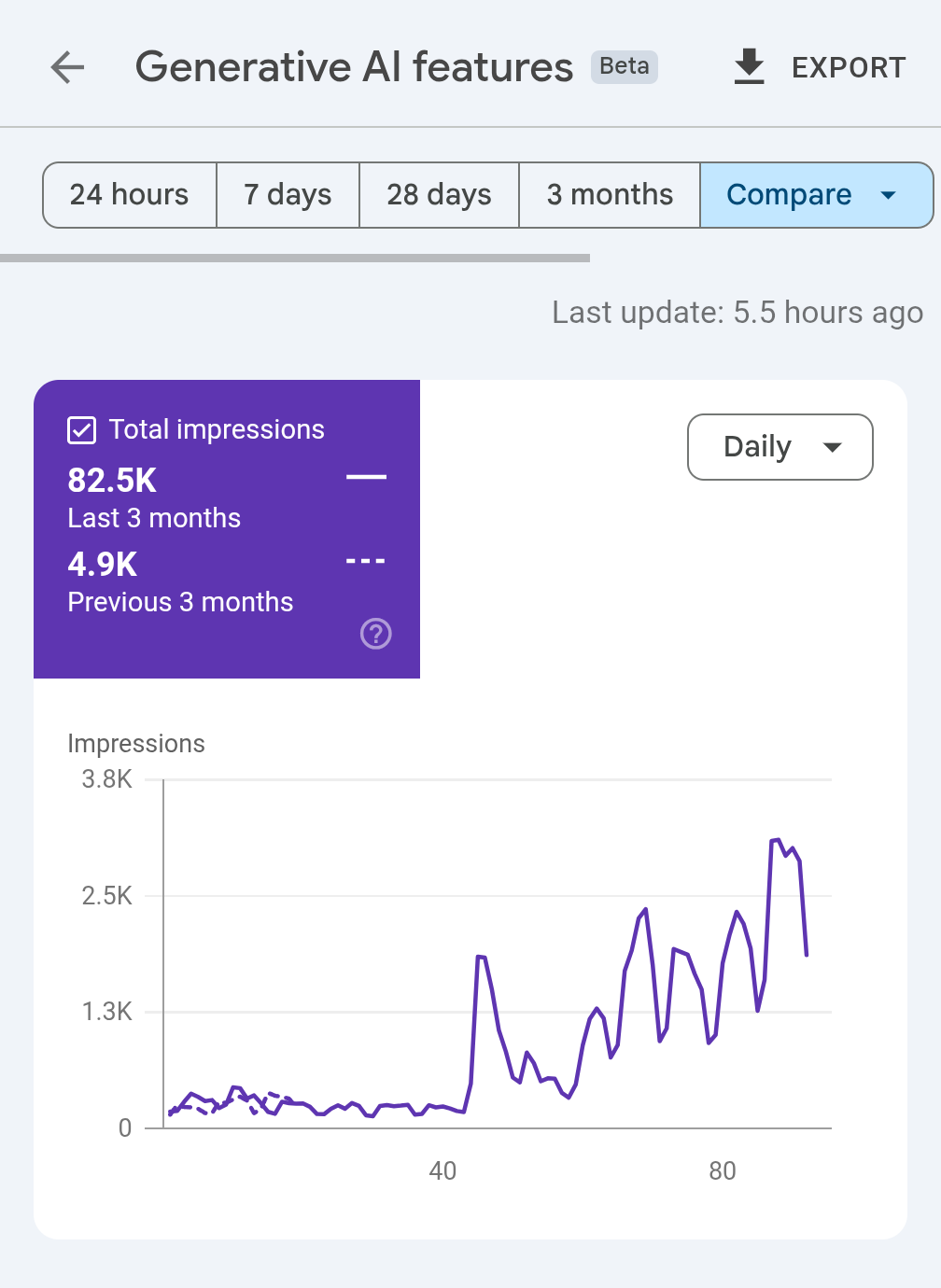
Source: Google Search Console — Generative AI features report, this law firm's own property.
Pairing Your Website With AI SEO for Calgary Law Firms
A technically excellent, fast-loading, fully schema-marked site still needs a visibility strategy behind it — otherwise it's simply a well-built site nobody finds. That's the natural next step: AI SEO for Calgary law firms, focused specifically on earning citations in Google AI Overviews, ChatGPT, Gemini, and Perplexity for what Calgary and Alberta clients are actually asking.
The two services run on the same technical foundation — schema markup, entity signals, content structure — which is why firms that invest in an AI-optimized website almost always see the strongest results pairing it with a dedicated AI SEO strategy rather than treating visibility as an afterthought.
What to Expect in the First 90 Days
Calgary's energy-sector clients tend to move fast when they need a lawyer, so the build is scoped around getting the highest-traffic practice pages live early rather than launching everything at once. For the full phase-by-phase timeline, see how long an AI-optimized website build actually takes in Calgary.
A new site with zero search history behind it gets the biggest lift from an AI SEO push started right at launch, which is why most Calgary engagements roll straight from build into ongoing SEO rather than pausing in between.
How the Build Actually Runs
It opens with an audit of what's already live and a strategy call to sort out priorities, then Lexscale.ai handles the design, the build, the schema, and the Law Society of Alberta-compliant copywriting directly — no outsourced pieces, no generic template dropped in and left to chance. This is the same AI website design methodology we run for firms across North America, adapted here for what an Alberta energy-and-legal market actually needs.
From first call to a fully launched site usually takes a few weeks, and most firms roll straight into AI SEO once it's live rather than treating the website as a finished, standalone project. If you want the wider view before locking into a website build specifically, the Calgary AI growth hub is the better starting point.
Related Reading: AI Website Design Insights
Calgary Insights: Questions Answered Directly
From My Experience — James Harmiden
The Calgary sites I get called in to fix almost always have the same tell: they were built for a professional-services buyer who doesn't exist in this market anymore. Slow load times, a generic template, schema markup that's either missing or was set up once years ago and forgotten. That might have been fine when a firm's clients were mostly long-time locals who found them through a referral. It's a real liability when a growing share of the people landing on that page work in energy or tech, spend their day around genuinely fast software, and judge a firm's competence by how the website performs in the first three seconds.
I've rebuilt enough of these to know the fix is rarely about making the site prettier. It's about ripping out a decade of WordPress plugin bloat and building something lean and properly structured from the ground up — the exact migration is covered in how to move a Calgary law firm website off WordPress without losing your Google rankings — and the Law Society of Alberta's specific ban on "specialist" and "expert" language means the copy has to be rewritten with real care too, not just sped up.
What I keep telling Calgary firms is the same thing I'd want to hear: you're not competing against the firm down the street anymore. You're competing against whatever website an AI system decides to trust, and against a client base that's changing faster than almost anywhere else in the country. Build for that, and get better results than whatever you were already paying an agency for — often for less than you're spending now.
— James Harmiden, Founder & CEO, Lexscale.ai